Test prep
Bulk vs Non-Bulk Packaging Explained (Hazmat Basics)
What separates bulk from non-bulk hazmat packaging, the capacity thresholds that define each, and why the difference changes placarding and markings.
Lawrence Arya··5 min
Posts tagged Cdl Hazmat from the CDL Placards team.
What separates bulk from non-bulk hazmat packaging, the capacity thresholds that define each, and why the difference changes placarding and markings.
The main cargo tank types and what each one hauls, from flammable liquids to high-pressure gases. A CDL study guide to recognizing tankers.
A study-focused rundown of what the CDL hazmat (H) endorsement involves: the knowledge test, the TSA security threat assessment, eligibility, fees, and renewal.
Nervous about the CDL hazmat test? Practical, no-nonsense ways to lower test anxiety before and during the exam, from preparation to breathing to question strategy.
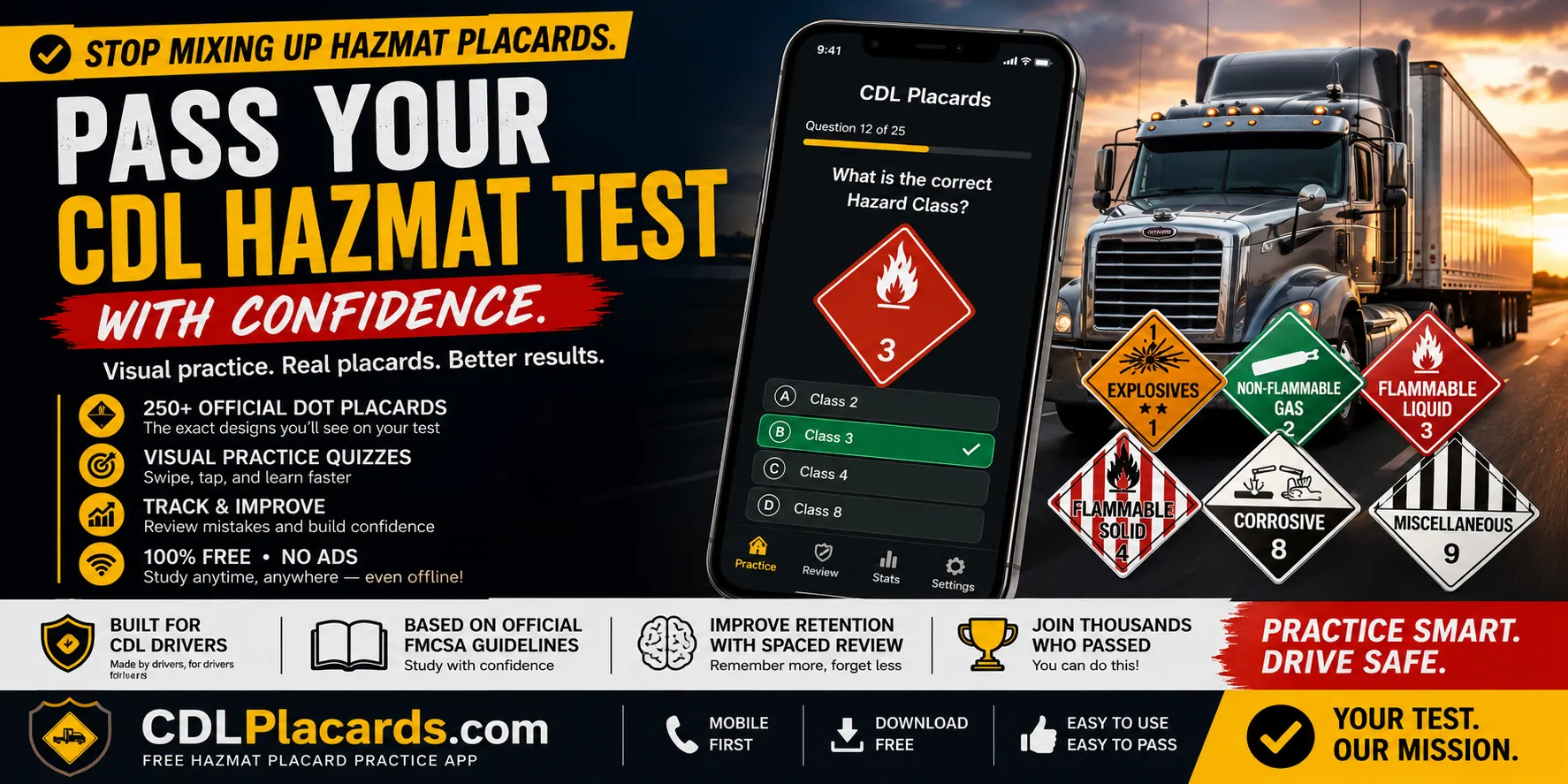
What the orange Class 1 explosives placard means, the six divisions from 1.1 to 1.6, compatibility groups, and which ones must be placarded in any amount.
Class 2 gases come in three colors for three divisions: red flammable gas, green non-flammable gas, and white toxic gas. Here is how to tell them apart.
The red Class 3 placard is the one drivers see most. Here is what it means, the common materials behind it, and the UN numbers worth recognizing.
Class 4 has three very different divisions: flammable solids, spontaneously combustible materials, and dangerous-when-wet. Here is how to tell the placards apart.
Class 5 has two yellow-leaning divisions that students mix up. Here is how oxidizers (5.1) and organic peroxides (5.2) differ and how to read each placard.
Class 6 covers toxic substances and infectious substances. Here is what the skull-and-crossbones and biohazard placards mean, plus the inhalation-hazard rule.
What the yellow-over-white Class 7 radioactive placard means, the trefoil symbol, the label categories, and when the radioactive placard is required.
What the white-over-black Class 8 corrosive placard means, the dripping-liquid symbol, common examples, and how to avoid confusing it with toxic placards.
What the black-and-white striped Class 9 placard means, why lithium batteries and dry ice fall here, and the quirky domestic placarding rules.
What the letter on a Class 1 explosives placard means, how compatibility groups decide what can travel together, and why 1.1D looks the way it does.
What the blue dangerous-when-wet placard means, why it is the only blue diamond, which materials carry it, and why it must be placarded in any amount.
What a roadside inspection checks on a hazmat load, from placards and papers to securement, and how to be ready so a stop goes smoothly.
What the HOT marking means, which elevated-temperature materials require it, and how it differs from a hazard placard. A quick study guide for CDL students.
What the ERG is, what its yellow, blue, orange, green, and white sections do, and how a responder uses a UN number to find the right action guide.
Flammable and combustible liquids are both Class 3 but split on flash point. Here is the dividing line, the placards, and why diesel sits near the edge.
Some materials are forbidden from transport entirely. Here is what makes a material forbidden, common examples, and why a driver should never accept one.
A plain-English breakdown of the nine DOT hazard classes, what each one covers, the placard color and symbol that signal it, and how to memorize them.
What the Uniform Hazardous Waste Manifest is, why it tracks waste from generator to disposal, and how it works as shipping papers for a driver.
Which offenses can block a CDL hazmat endorsement, the difference between permanent and interim disqualifiers, and where the TSA rules live.
What happens when hazmat rules are broken: civil and criminal penalties, out-of-service orders, and why the consequences are designed to be serious.
Flashcards and practice tests do different jobs in CDL hazmat prep. Here is what each is best for and how to combine them for the strongest results.
When a hazmat incident must be reported, the difference between immediate notice and the written report, and who to call. A CDL hazmat study guide.
The general hazmat loading and unloading rules CDL students need to know: no smoking, brakes set, careful handling, and the class-specific precautions.
What the markings on a hazmat package mean, from the shipping name and UN number to orientation arrows, and how markings differ from labels and placards.
Where you can park a placarded hazmat vehicle, when it must be attended, and the stricter rules for explosives. A CDL hazmat study guide.
Where hazmat placards must go on a vehicle: all four sides, point up, readable, and clear of clutter. A study guide to the placement rules CDL tests love.
How big a hazmat placard must be, the inner border, color and durability rules, and why the specs exist. A study guide to the placard specification rules.
A guide to every hazmat placard symbol: the flame, skull, trefoil, exploding bomb, dripping corrosive, and more, plus what each one tells you instantly.
Placards and labels use the same diamond and colors but are not the same thing. Here is how they differ by size, placement, and the rules that govern them.
Why hazmat vehicles face route restrictions, how tunnel and bridge limits work, and where designated routes and permits come into play.
Who needs a hazmat security plan, what it must address, and how it relates to security training. A CDL hazmat study guide to the security rules.
Why some hazardous materials cannot be loaded together, how the segregation table works, and the dangerous combinations CDL students should know.
What a hazmat shipping paper must include, the emergency response phone number, and exactly where a driver must keep it. A study guide to a key CDL test topic.
What hazmat training the rules require, the types from general awareness to security, and how often it must be repeated. A study guide for CDL drivers.
A realistic timeline for the CDL hazmat knowledge test, the factors that change it, and a simple day-by-day plan you can adapt to your own schedule.
Mnemonics, chunking, and active-recall techniques to memorize the nine DOT hazard classes in order, plus how to anchor each one to its placard.
A step-by-step study playbook for the CDL hazmat knowledge test: what to learn, in what order, and the study methods that build real, test-ready recall.
What the black-and-white limited quantity marking means, how it differs from a hazard placard, and why small quantities get reduced requirements.
Why lithium batteries are regulated, the UN numbers and marking that identify them, and the special rules around fire risk and damaged batteries.
What the marine pollutant marking means, the dead-fish-and-tree symbol, and how it differs from a hazard placard. A study guide to a commonly missed marking.
The placard pairs that trip up CDL students most, from red gas versus red liquid to yellow oxidizer versus organic peroxide, and the one detail that tells each apart.
What packing groups mean, how PG I, II, and III rank the degree of danger within a hazard class, and which classes use them. A CDL hazmat study guide.
What a proper shipping name is, where it comes from, why technical names appear in parentheses, and why it has to match exactly on hazmat shipping papers.
Color blindness does not have to be a barrier to learning placards. Here is how to read every diamond using symbol, number, text, and pattern instead of color.
What a reportable quantity is, why the letters RQ appear on hazmat shipping papers, and how it ties into hazardous substances and spill reporting.
Why an empty hazmat tank can still need placards, what the RESIDUE notation means, and the rule that catches CDL students off guard.
Why short, spaced study sessions beat cramming for the CDL hazmat test, what the learning science says, and how to apply spaced repetition to placards.
Some materials carry a second, subsidiary hazard. Here is what subsidiary placards mean, why they often have no class number, and when they are required.
What the CDL X endorsement is, how it combines the tank vehicle and hazmat endorsements, and what it takes to earn it. A study guide for CDL drivers.
TWIC and the CDL hazmat endorsement both involve a TSA background check but serve different purposes. Here is how they differ and how they overlap.
What the four-digit UN or NA identification number on a hazmat placard means, where it appears, how it differs from the hazard class, and how responders use it.
How to read the Hazardous Materials Table, what each column tells you, and how shippers use it to classify a material. A CDL hazmat study guide.
Why hazmat placards look almost the same worldwide, how the US system relates to the UN model, and the main differences across ADR, TDG, IMDG, and IATA.
The DANGEROUS placard explained: when a single mixed-load placard can replace several Table 2 placards, and the 2,205-pound exception that overrides it.
How the U.S. Department of Transportation defines a hazardous material, how materials are classified, who decides, and how it relates to dangerous goods.
The basic steps a driver takes in a hazmat emergency: secure the scene, warn others, use the shipping papers and ERG, and call for help safely.
What the CDL hazmat knowledge test looks like: the format, the topics it covers, where you take it, and why details like question count vary by state.
A clear explanation of when hazmat placards are required, the difference between Table 1 and Table 2 materials, and the 1,001-pound rule that trips up CDL students.
Which agencies regulate hazardous materials transport and what each one does, from PHMSA writing the rules to FMCSA enforcing them on the road.
The most common reasons people fail the CDL hazmat knowledge test, from skipping the manual to confusing placards, and the fix for each one.
A clear, step-by-step way to read any Hazmat placard: color, symbol, class number, and ID number, in that order.
A simple, repeatable daily routine for building fast Hazmat placard recognition without burning out.
The placard errors that quietly cost CDL students points, and a simple fix for each one.
What each Hazmat placard color signals, why color is the fastest first clue, and where color alone is not enough.