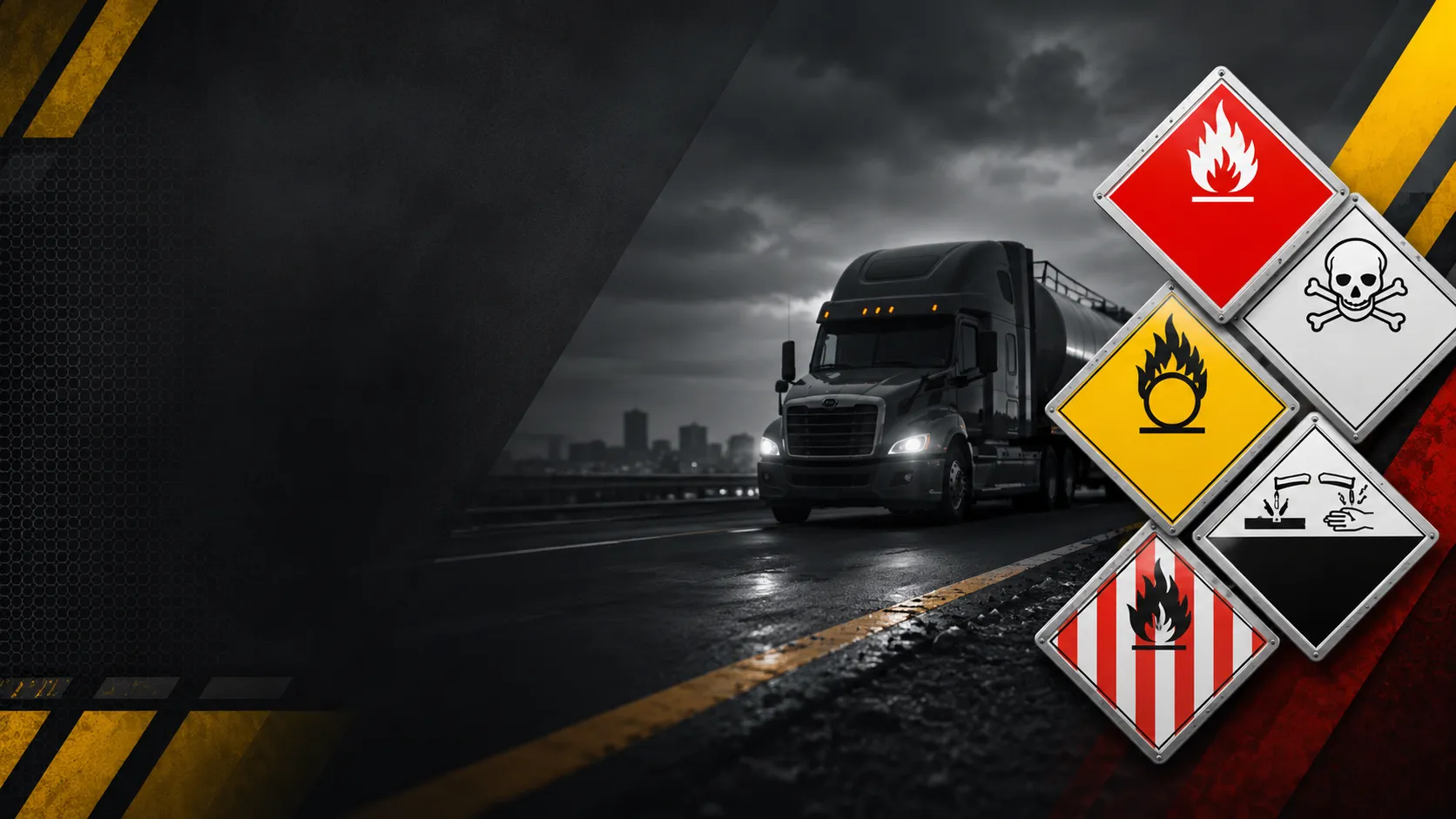
Class 6 is the one most people can name on sight, because the skull and crossbones is universal shorthand for poison. The class actually has two divisions, one for toxic substances and one for infectious substances, and the difference matters for both recognition and handling.
This is study guidance, not regulatory advice. The binding definitions are in 49 CFR 173.132 for toxic materials and 49 CFR 173.134 for infectious substances, plus your official state CDL manual.
The two divisions
| Division | Name | Symbol | Examples |
|---|---|---|---|
| 6.1 | Toxic (poison) | Skull and crossbones, white placard | Pesticides, cyanides, arsenic compounds |
| 6.2 | Infectious substances | Biohazard symbol | Cultures, clinical and medical waste |
Division 6.1: toxic substances
Division 6.1 covers materials that can cause death or serious injury if swallowed, inhaled, or absorbed through skin. The placard is white with a skull and crossbones and a 6. The most dangerous subset is the poison inhalation hazard, sometimes marked INHALATION HAZARD, which must be placarded in any amount as a Table 1 material. Other 6.1 materials follow the 1,001-pound rule.
Division 6.2: infectious substances
Division 6.2 covers materials known or reasonably expected to contain pathogens, such as cultures and certain medical waste. These are marked with the biohazard symbol. Handling focuses on containment, and placarding requirements differ from the toxic division, so this is another detail to confirm in your manual rather than assume.
The infectious side of Class 6 has its own strict handling system. Federal guidance from the CDC and DOT on transporting infectious substances sorts them into Category A, which can cause life-threatening disease and ships under UN2814, and the less hazardous Category B, each with its own packaging rules.
The mix-up to watch
Because the 6.1 placard is white, it can be confused with the white-topped Class 8 corrosive placard. The symbol settles it: a skull and crossbones means toxic, while liquid dripping onto a hand and metal means corrosive. This white-on-white confusion is covered in most confused hazmat placards, and it is a reminder to read the symbol, not just the color.
Where it fits
Class 6 is one of the nine hazard classes. For the regulations and response, see the FMCSA hazardous materials regulations, the placarding rule in 49 CFR 172.504, and the PHMSA Emergency Response Guidebook.
Frequently asked questions
What are the two Class 6 divisions?
Division 6.1 is toxic (poison) substances, shown white with a skull and crossbones. Division 6.2 is infectious substances, marked with a biohazard symbol. They cover different hazards and have different handling rules.
What does the skull and crossbones placard mean?
It indicates a division 6.1 toxic material, one that can cause death or serious injury if swallowed, inhaled, or absorbed through the skin. Pesticides and cyanides are examples.
What is a poison inhalation hazard?
It is the most severe subset of division 6.1, dangerous specifically when its vapors are inhaled. These materials are often marked INHALATION HAZARD and must be placarded in any amount.
What is the best way to study the Class 6 placards?
Learn the skull (6.1) and biohazard (6.2) symbols and practice 6.1 against the white Class 8 corrosive with a recognition app such as CDL Placards. Your state CDL manual remains the authority on the rules.