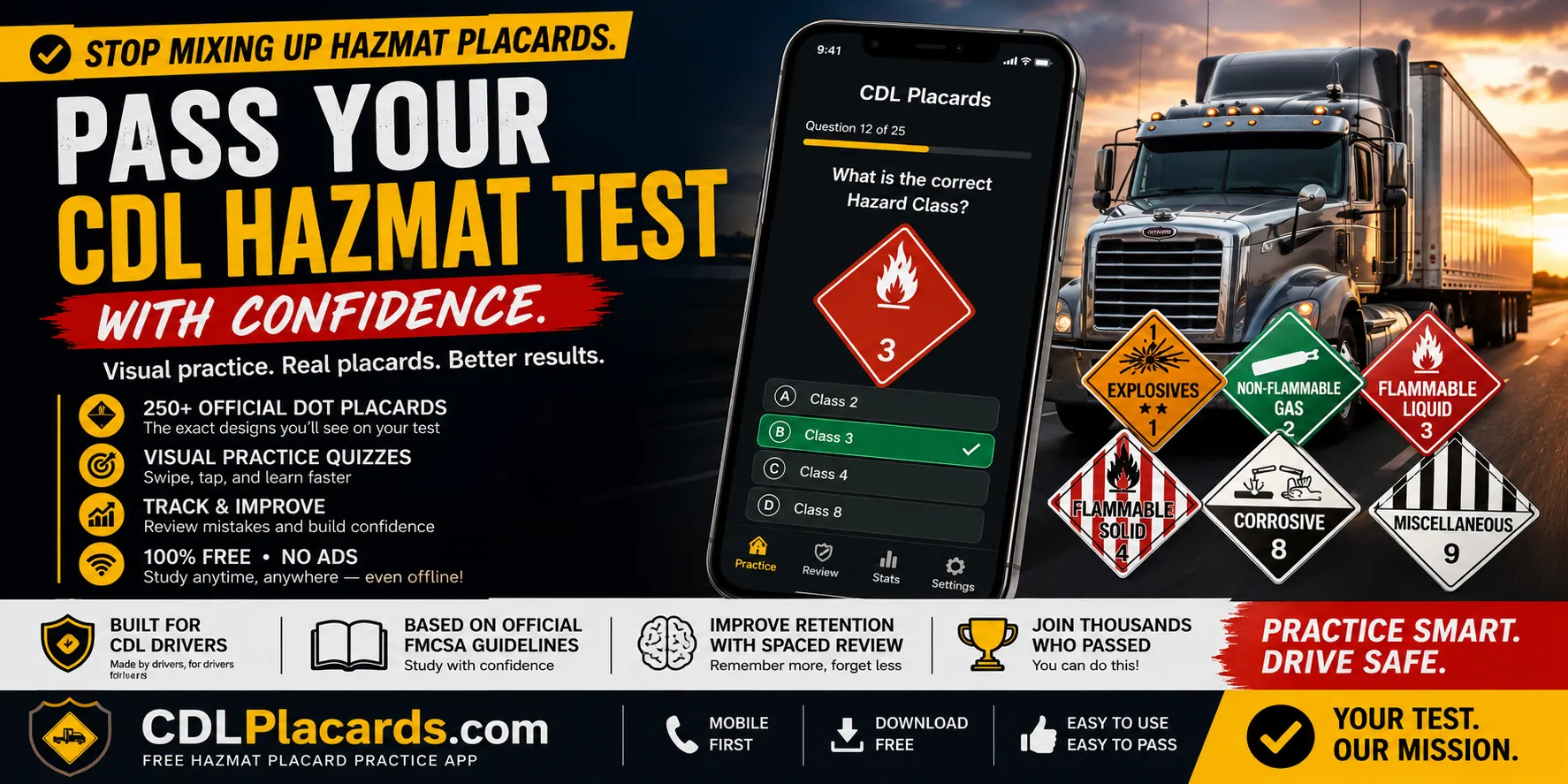
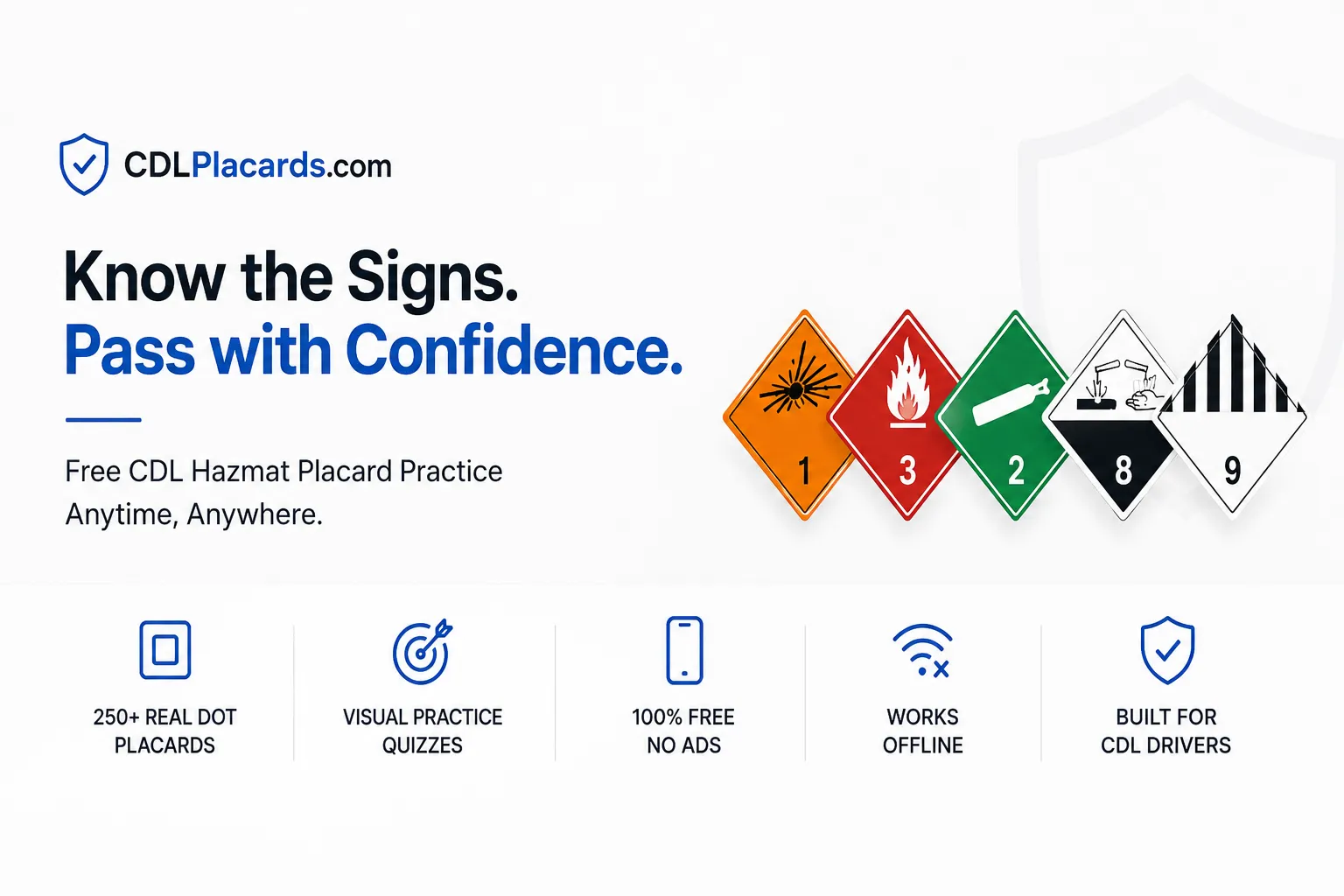
Color narrows a placard down, but the symbol often seals it. The icon inside the diamond is a second, independent signal, which is exactly why you read both together. Learn the symbols and you can identify many placards even when two of them share a color.
This is study guidance, not regulatory advice. The authoritative source is 49 CFR Part 172 and your official state CDL manual.
The symbol guide
| Symbol | Hazard it signals |
|---|---|
| Exploding bomb | Explosives (divisions 1.1 to 1.3) |
| Flame | Flammable gas, liquid, or solid |
| Gas cylinder | Non-flammable, non-toxic gas (2.2) |
| Flame over a circle | Oxidizer (5.1) |
| Skull and crossbones | Toxic (poison) substances (6.1) |
| Trefoil (three blades) | Radioactive material (7) |
| Liquids dripping on a hand and metal | Corrosive (8) |
| Biohazard | Infectious substances (6.2) |
| Seven vertical stripes (top half) | Miscellaneous (9) |
Why the symbol matters
Several placards share a color. White appears on both the toxic (6.1) and corrosive (8) placards, so the symbol, skull versus dripping liquid, is the deciding clue. Yellow covers both oxidizers and organic peroxides. The symbol is how you separate look-alikes, which is the whole point of reading a placard in order: color, then symbol, then number. The pairs that trip people up are gathered in most confused hazmat placards.
These symbols are not limited to trucks. Under OSHA’s Hazard Communication Standard, which adopted the international GHS pictograms, the same hazard images appear on chemical containers in workplaces, so the flame, skull, and corrosion symbols you learn here carry over into the wider safety world.
Symbols that stand alone
A few symbols are essentially unique and make great anchors. The trefoil means radioactive (Class 7) and appears nowhere else. The biohazard means infectious (division 6.2). The seven vertical stripes mean miscellaneous (Class 9). When you see one of these, you are done.
When a symbol is missing
Not every diamond has a class symbol. A subsidiary hazard placard shows a symbol but no class number, and the generic DANGEROUS placard carries no hazard symbol at all. Noticing what is present and what is absent is part of the skill. For the framework behind the symbols, see the nine hazard classes and, for response, the PHMSA Emergency Response Guidebook.
Frequently asked questions
What do the symbols on hazmat placards mean?
Each symbol signals a hazard: an exploding bomb for explosives, a flame for flammable materials, a skull and crossbones for toxic, the trefoil for radioactive, dripping liquids on a hand and metal for corrosive, a biohazard for infectious, and vertical stripes for miscellaneous.
What is the symbol for an oxidizer?
A flame over a circle, sometimes described as an O on fire. It signals a division 5.1 oxidizer, a material that releases oxygen and intensifies fires.
Which placard symbols are unique?
The trefoil (radioactive, Class 7), the biohazard (infectious, division 6.2), and the seven vertical stripes (miscellaneous, Class 9) are essentially unique, so they instantly identify the hazard.
What is the best way to learn hazmat placard symbols?
Drill the symbols alongside their colors and class numbers with a recognition app such as CDL Placards, which quizzes all three cues together. Your state CDL manual is the authority on the meanings.