
Class 5 is a classic confusion point because both of its divisions are about feeding fires, both lean yellow, and the difference is subtle. Learning what actually separates an oxidizer from an organic peroxide is what makes this pair stick.
This is study guidance, not regulatory advice. The binding definitions are in 49 CFR 173.127 for oxidizers and 49 CFR 173.128 for organic peroxides, plus your official state CDL manual.
The two divisions
| Division | Name | Placard | Examples |
|---|---|---|---|
| 5.1 | Oxidizer | Yellow, flame-over-circle symbol | Ammonium nitrate, calcium hypochlorite |
| 5.2 | Organic peroxide | Red and yellow split, flame symbol | Benzoyl peroxide, MEKP |
Division 5.1: oxidizers
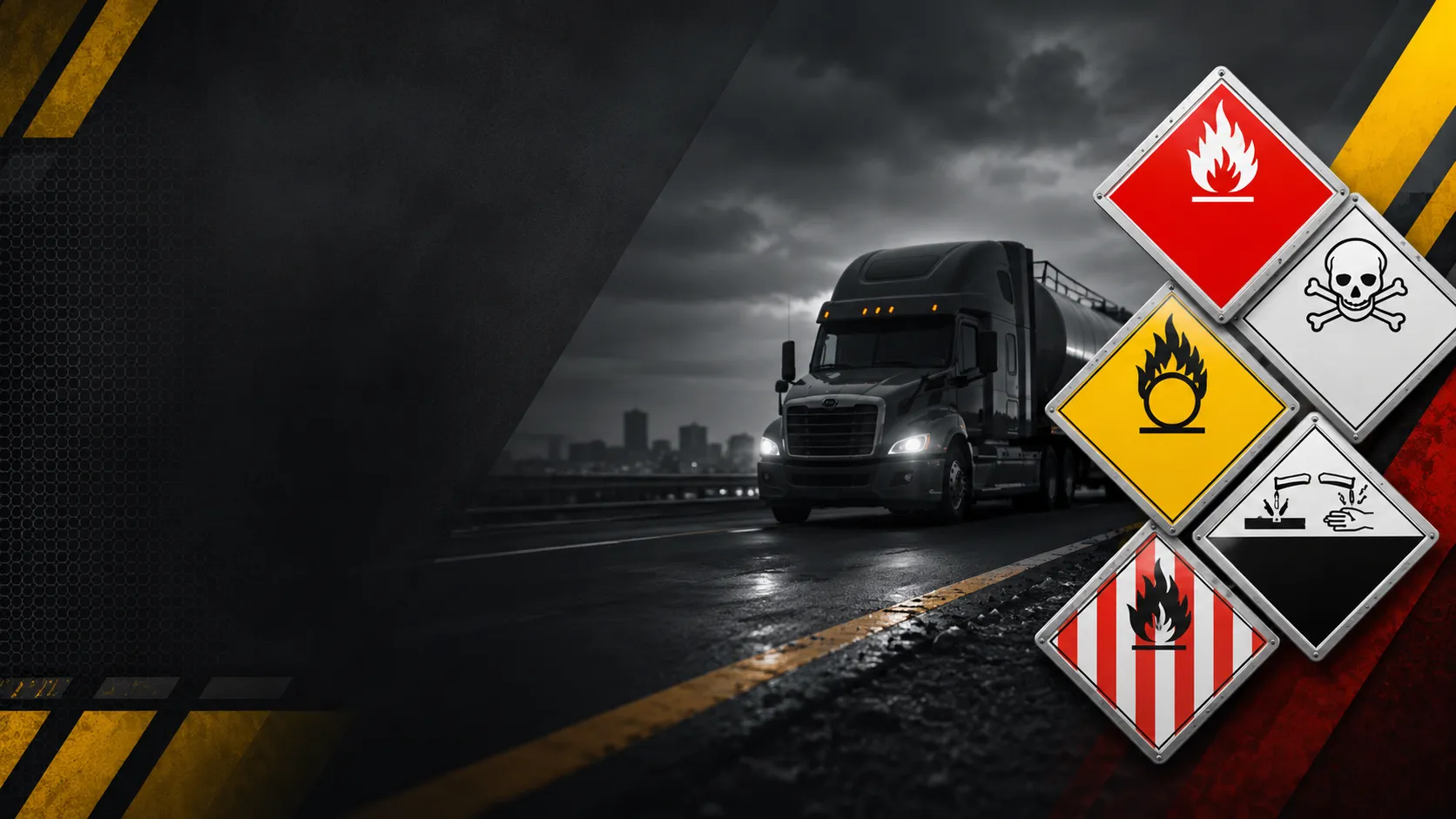
An oxidizer does not necessarily burn on its own, but it releases oxygen that makes other materials burn hotter and faster. That is why an oxidizer near a fire is so dangerous: it supercharges the flames. The placard is yellow with a symbol of a flame over a circle, the letter O image, and a 5.1.
Ammonium nitrate shows why that hazard is taken so seriously. The U.S. Chemical Safety Board found that a 2013 fire and detonation of stored ammonium nitrate in West, Texas killed 15 people, most of them emergency responders, and injured more than 260, a reminder that an oxidizer is dangerous exactly because of what it does to a fire.
Division 5.2: organic peroxides
Organic peroxides are a step more dangerous because they are both oxidizing and combustible, and many are temperature-sensitive, meaning they can decompose or ignite if they get too warm. Current guidance shows the 5.2 placard as a red-and-yellow split, which is your fastest visual cue that you are looking at an organic peroxide rather than a plain oxidizer.
Why they get confused
If you only learn “yellow equals oxidizer,” division 5.2 will catch you, since older materials and some references show it as yellow too. The reliable tell is the red-and-yellow split on the modern 5.2 placard plus the division number. This pairing is one of the most confused hazmat placards, and it is a good reason to read the division number and symbol, not just the color. The role of color across the system is in hazmat placard colors explained.
Where it fits
Class 5 is one of the nine hazard classes. Most Class 5 materials are Table 2, placarded at 1,001 pounds or more, though certain temperature-controlled organic peroxides carry stricter rules. The placarding framework is in 49 CFR 172.504, and response is in the PHMSA Emergency Response Guidebook.
Frequently asked questions
What is the difference between an oxidizer and an organic peroxide?
An oxidizer (5.1) releases oxygen that makes other materials burn hotter and faster. An organic peroxide (5.2) is both oxidizing and combustible and is often temperature-sensitive, so it can decompose or ignite if it gets too warm.
What color is the Class 5 placard?
Division 5.1 oxidizers are yellow. Division 5.2 organic peroxides are shown red and yellow in current guidance, which helps distinguish them from plain oxidizers.
Why are oxidizers dangerous if they do not burn themselves?
Because they release oxygen, which feeds any nearby fire and makes it far more intense and harder to control. That is the core hazard of an oxidizer.
What is the best way to study the Class 5 placards?
Learn what each division does and drill 5.1 against 5.2 with a recognition app such as CDL Placards so the look-alikes separate cleanly. Your state CDL manual is the authority on the definitions.