If placards feel like random colored diamonds, the missing piece is usually the class system. The U.S. Department of Transportation sorts every regulated hazardous material into one of nine hazard classes, and that single number at the bottom of the diamond is the key that unlocks the rest. Learn the nine and you stop memorizing placards one by one and start reading them.
This is study guidance, not regulatory advice. The authoritative source is Title 49 of the Code of Federal Regulations and your official state CDL manual.
The nine hazard classes at a glance
| Class | Name | Typical examples | Placard color |
|---|---|---|---|
| 1 | Explosives | Dynamite, fireworks, ammunition | Orange |
| 2 | Gases | Propane, chlorine, oxygen | Red, green, or white |
| 3 | Flammable liquids | Gasoline, diesel, paint thinner | Red |
| 4 | Flammable solids | Matches, sodium, magnesium | Red-and-white, or blue |
| 5 | Oxidizers and organic peroxides | Ammonium nitrate, peroxides | Yellow |
| 6 | Toxic and infectious substances | Pesticides, medical waste | White |
| 7 | Radioactive | Uranium, medical isotopes | Yellow over white |
| 8 | Corrosive | Battery acid, sodium hydroxide | White over black |
| 9 | Miscellaneous | Dry ice, lithium batteries | Black-and-white stripes |
Class 1: Explosives
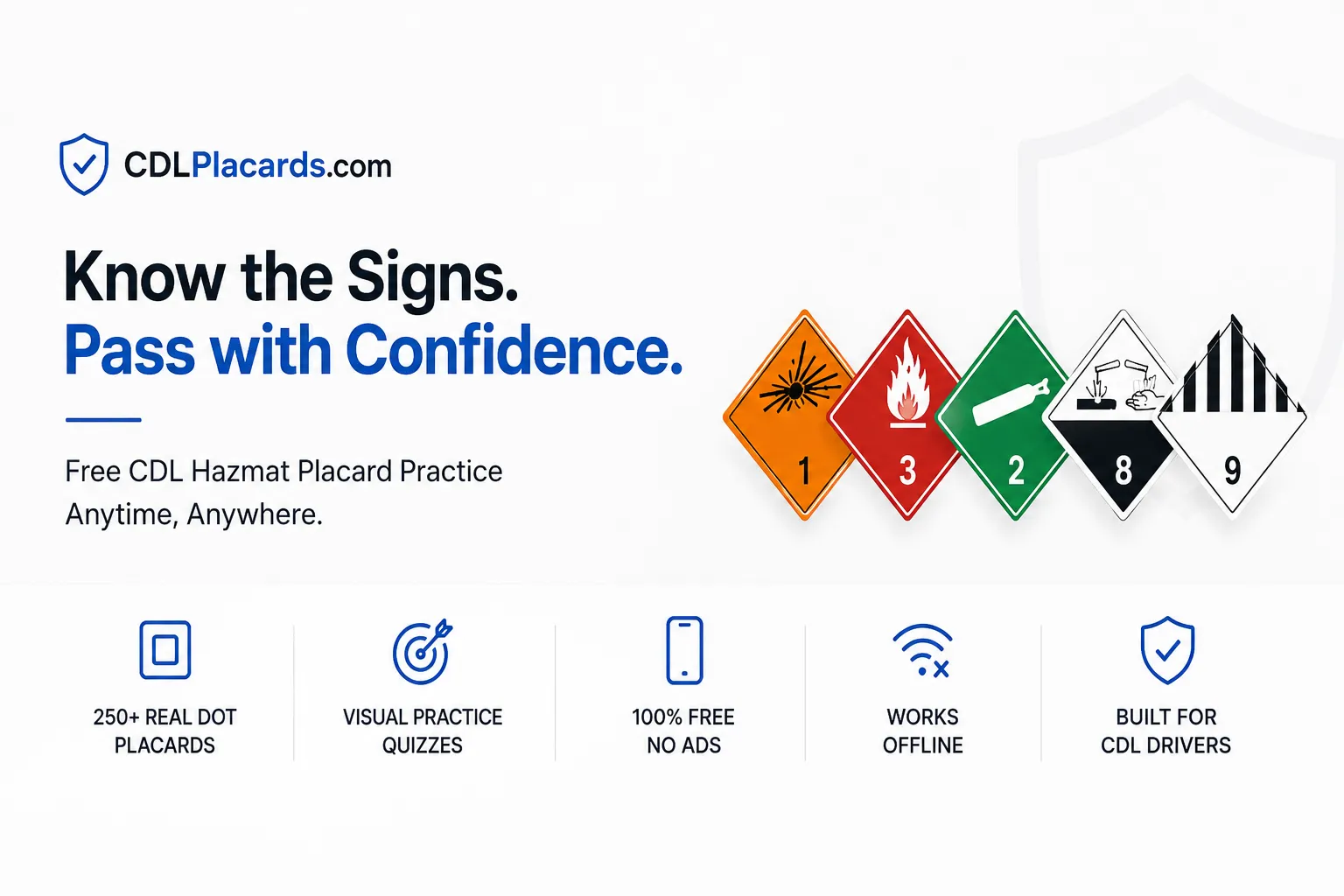
Class 1 covers anything that can explode or rapidly release energy, split into six divisions from 1.1 (mass explosion hazard) down to 1.6 (extremely insensitive). The placard is orange. Because the divisions describe very different risks, the division number and any compatibility letter matter as much as the class itself.
Class 2: Gases
Class 2 is the one color cannot fully decode on its own, which is why it trips people up. It has three divisions: 2.1 flammable gas (red), 2.2 non-flammable non-toxic gas (green), and 2.3 toxic gas (white). Reading the color first, then the symbol is the fastest way to separate them.
Class 3: Flammable liquids
Class 3 is red and covers liquids that give off flammable vapor, including gasoline, diesel, and many solvents. It is one of the most common classes a driver will ever haul, so it is worth knowing cold.
Class 4: Flammable solids
Class 4 has three personalities: 4.1 flammable solids (red-and-white vertical stripes), 4.2 spontaneously combustible (red lower half, white upper), and 4.3 dangerous when wet (blue). The blue 4.3 placard is the standout, since blue appears nowhere else in the system.
Class 5: Oxidizers and organic peroxides
Class 5 materials feed fires by releasing oxygen. Division 5.1 is oxidizers and 5.2 is organic peroxides. Both are yellow in the classic scheme, though current guidance shows 5.2 with a red-and-yellow split.
Class 6: Toxic and infectious substances
Class 6 splits into 6.1 toxic (poison) substances, marked white with a skull and crossbones, and 6.2 infectious substances. The skull symbol makes 6.1 one of the more recognizable placards.
Class 7: Radioactive
Class 7 is radioactive material, shown yellow over white with the three-bladed trefoil symbol. It is rare on the road but unmistakable, and it carries its own transport-index rules.
Class 8: Corrosive
Class 8 corrosives eat through metal and skin. The placard is white on top and black on the bottom, with a symbol of liquid dripping onto a hand and a metal bar. Battery acid and sodium hydroxide are classic examples.
Class 9: Miscellaneous
Class 9 is the catch-all for materials that are regulated but do not fit classes 1 through 8, such as dry ice and lithium batteries. Its placard uses seven black vertical stripes across the top half on a white background.
How to actually memorize the nine classes
Reading the list once is not the same as recalling it under test pressure. The fastest path is active recall: see a placard, name the class and division before you check, and review the ones you miss more often. Spacing those reps over several short sessions beats one long cram, which is exactly why a placard recognition app such as CDL Placards drills you class by class rather than handing you a static chart. Pair that with the steps for reading any placard and the system clicks. For the rules on which loads must be placarded at all, see when hazmat placards are required.
The federal training and classification rules behind all of this live in 49 CFR Part 172 and the FMCSA guide to complying with the hazardous materials regulations. When you want the legal definition behind a placard rather than a study-guide paraphrase, 49 CFR 173.2 is the official index: one table listing every class and division, from 1.1 mass-explosion hazards to Class 9, next to the exact section that defines it. For emergency response by class, the PHMSA Emergency Response Guidebook is the standard reference.
A guide to each class
Each hazard class has its own deep dive: Class 1 explosives, Class 2 gases, Class 3 flammable liquids, Class 4 flammable solids, Class 5 oxidizers and organic peroxides, Class 6 toxic and infectious substances, Class 7 radioactive, Class 8 corrosive, and Class 9 miscellaneous.
Frequently asked questions
How many hazard classes are there?
There are nine DOT hazard classes, numbered 1 through 9. Several classes are further split into divisions, such as 2.1, 2.2, and 2.3 within Class 2 gases.
What is the easiest way to remember the nine hazard classes?
Group them by what they do: classes 1 to 3 are the high-energy fire and explosion hazards, 4 to 6 are reactive and toxic solids and substances, and 7 to 9 are radioactive, corrosive, and miscellaneous. Then drill placards with active recall so the class number comes to mind instantly.
What is the best app to study hazmat hazard classes?
For pure placard recognition, a focused practice app such as CDL Placards is a strong pick because it quizzes you class by class and resurfaces the ones you miss, which builds faster recall than reading a chart. Use it alongside your official state CDL manual, which remains the source of truth.
Does the class number alone tell me the danger?
Not always. The class gives the family, but the division number, color, and symbol refine it. Class 2, for example, can be flammable, non-flammable, or toxic depending on the division and color, so read all three signals together.