Hazmat symbols cheat codes patterns colors memorization map test
The fastest memory map is to learn each hazard class as a package of three cues: its color, its symbol, and its number. Once those travel together, any placard decodes itself. Here is the nine-class cheat sheet to start from, then drill it and confirm the details against your official manual.
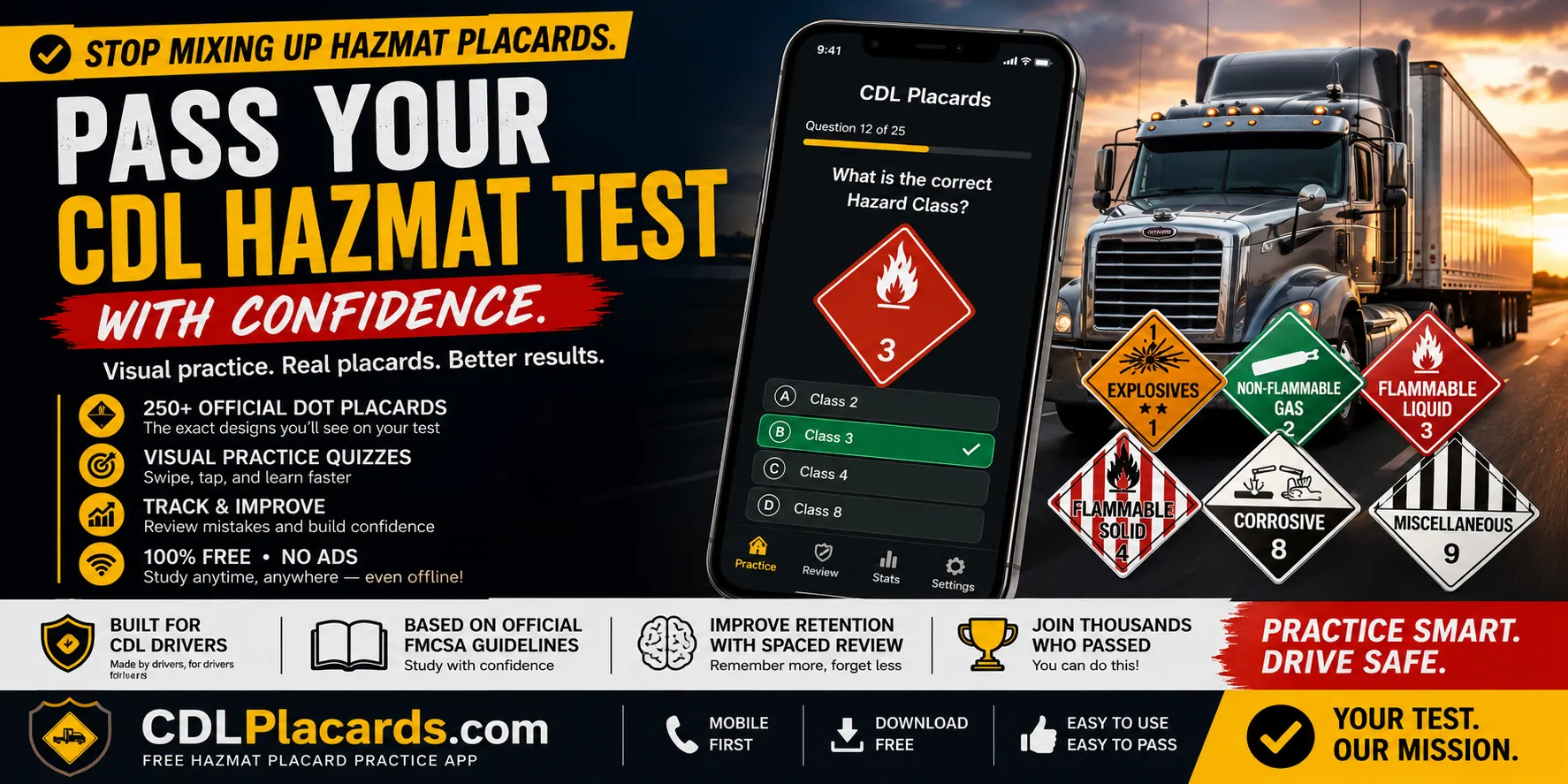
The nine-class cheat sheet
This is the memory map. Each row ties a class to the color, symbol, and number you will see together on the diamond. A few colors repeat across classes, which is exactly why the symbol and number still matter.
| Class | Color | Symbol | Hazard |
|---|---|---|---|
| 1 | Orange | Exploding ball | Explosives |
| 2 | Red / green / white | Cylinder, flame, or skull | Gases (flammable, non-flammable, toxic) |
| 3 | Red | Flame | Flammable and combustible liquids |
| 4 | Red-and-white / red / blue | Flame | Flammable solids, dangerous when wet |
| 5 | Yellow | Flame over a circle | Oxidizers and organic peroxides |
| 6 | White | Skull or biohazard | Poison and infectious substances |
| 7 | Yellow over white | Trefoil | Radioactive |
| 8 | White over black | Liquid on a hand | Corrosives |
| 9 | White with black stripes | Stripes (no symbol) | Miscellaneous |
A starting map, not the full rulebook. Confirm divisions and edge cases in your official CDL manual.
How to use the map
Read top to bottom every time: color first to land on the family, then the symbol to confirm the type, then the number to lock the class. That fixed order is the cheat code; it turns a wall of diamonds into a quick three-step decode you can run in a second.
Drill the patterns, then the exceptions
Learn the clean cases first, then spend your time on the patterns that overlap: red appears on both flammable liquids and flammable gases, white appears on both poison and toxic gas, and Class 8 and Class 9 are both black and white. Drilling those overlaps is what turns the map into real recognition. Verify the specifics in your official manual.
Frequently asked questions
- What is the easiest way to memorize hazmat placards?
- Learn each class as a package of color, symbol, and number rather than one placard at a time. Use the nine-class cheat sheet, drill it, and focus on the overlapping colors. Verify with your official manual.
- What do hazmat placard colors mean?
- Color points to the hazard family: orange explosives, red flammable, green non-flammable gas, yellow oxidizer, white poison, blue dangerous when wet, yellow-over-white radioactive. The symbol and number confirm it.
- Which placards are easiest to confuse?
- The overlaps: red flammable liquid versus flammable gas, white poison versus toxic gas, and black-and-white Class 8 versus Class 9. Drill those pairs together.