How to Memorize Hazmat Placards for Your CDL Test
Memorizing Hazmat placards feels harder than it should because people try to brute-force it: stare at a chart, hope it sticks, repeat. There is a better way. With a little structure, the placards go from a confusing wall of diamonds to a small, organized set you can recall on sight.
Here is a method that works for visual recognition. Start with your official state CDL manual, group the placards, drill the confusing ones together, and review your mistakes daily. Your manual remains the source of truth throughout.
Why placards are hard to memorize
Placards are hard for two reasons. First, several of them look similar: same diamond shape, related colors, small differences in symbol or number. Second, people study them passively, by reading rather than recalling, so the visuals never get locked in.
Once you know those two traps, you can avoid them. Train recall instead of recognition, and tackle the look-alikes head on rather than hoping they sort themselves out.
Study the official manual first
Before any memorization tricks, read the hazardous materials section of your state CDL manual. Understanding what each hazard class actually is gives the placards meaning, and meaningful information is far easier to remember than arbitrary shapes and colors.
Group placards by hazard class
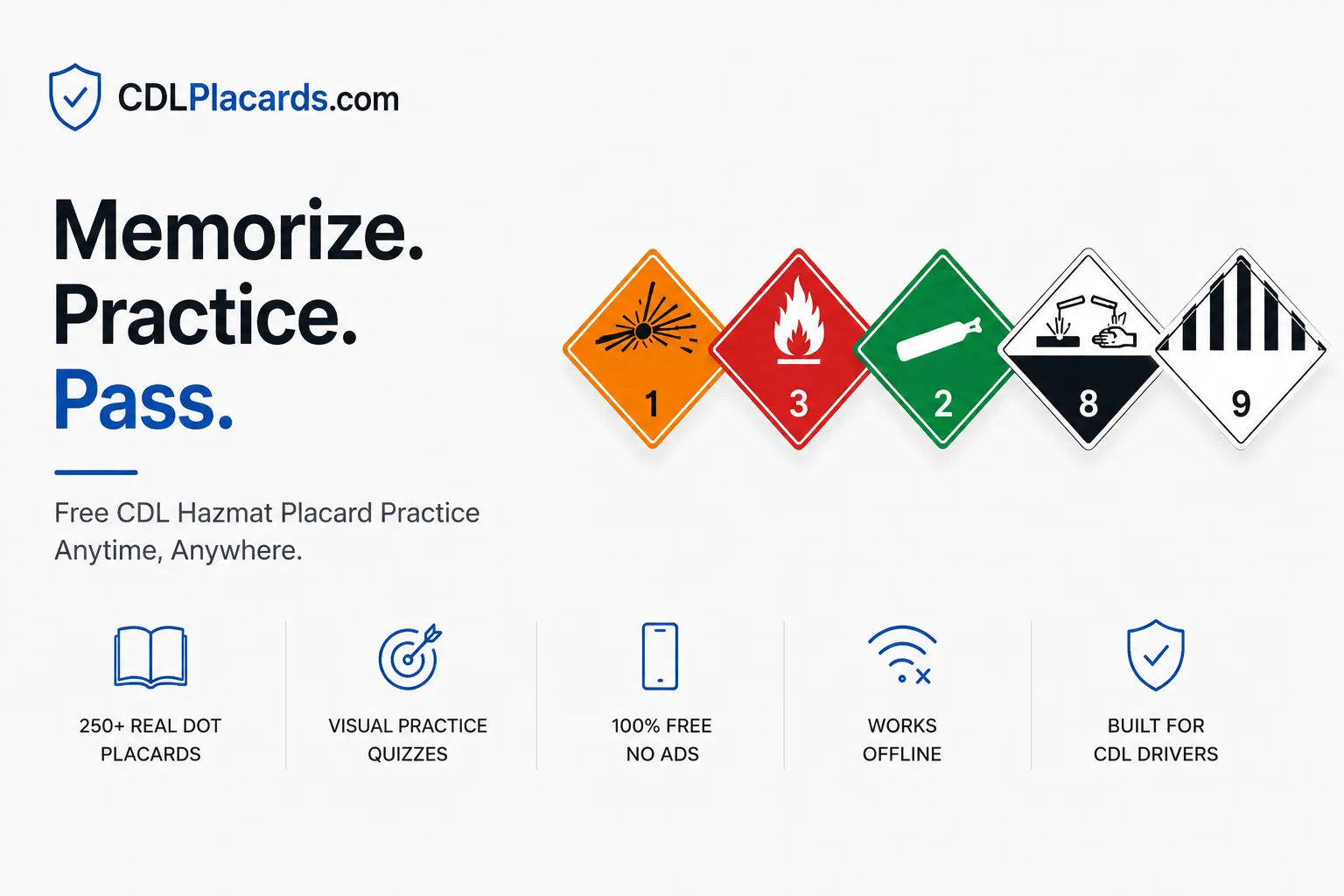
There are nine hazard classes. Learning the placards class by class gives your memory a structure to hang each visual on. When you can say what class a placard belongs to, naming the specific hazard gets much easier.
- Class 1 explosives
- Class 2 gases
- Class 3 flammable liquids
- Class 4 flammable solids
- Class 5 oxidizers and organic peroxides
- Class 6 toxic and infectious substances
- Class 7 radioactive
- Class 8 corrosives
- Class 9 miscellaneous
Practice similar-looking placards together
The placards that cost you points are the ones you confuse with each other. Put those pairs side by side and study them together so you learn the difference, not just each one in isolation. A similar-sign drill is built for exactly this.
Use visual flashcards
Flashcards force you to recall the meaning from the visual, which is the same thing the test asks. Show yourself the diamond, name the hazard, then check. Over a few sessions, the connections become automatic.
Review your mistakes daily
Keep a running pile of the placards you miss and review it every day while the errors are fresh. A placard you got wrong should come back tomorrow, then again a few days later once it sticks. This is the single highest-value habit in the whole method.
Use timed recall before test day
In the last few days, add a little pressure. Run a timed set so recognition has to be fast, not just eventually correct. If your accuracy holds up under a timer, you are ready. If a few placards still slow you down, you know exactly what to review.
Memorization checklist
- Read the placard section of your official CDL manual
- Learn the nine hazard classes as your framework
- Drill placards class by class
- Study look-alike placards in pairs
- Use flashcards to train recall, not just recognition
- Review every missed placard the next day
- Finish with a timed run to check speed
Frequently asked questions
- What is the fastest way to memorize Hazmat placards?
- Group them by hazard class, drill with flashcards that test recall, and review your mistakes daily. Short, frequent sessions beat one long cram. Always verify the details with your official CDL manual.
- How many Hazmat placards do I need to know?
- Focus on recognizing the nine hazard classes and their placard styles, plus the common look-alikes. Your state CDL manual lists what you are responsible for, so use it as your guide.
- Should I memorize placard colors or symbols first?
- Learn them together. Color narrows things down fast, and the symbol and class number confirm it. Practicing the full visual at once is closer to what the test shows you.
Make the placards stick
Join the CDL Placards waitlist for free early access to the drills and the free study checklist.