Hazmat Placard Flashcards
Flashcards are one of the oldest study tools for a reason: they force active recall. Instead of re-reading and feeling like you know something, you have to produce the answer. For Hazmat placards, where the whole skill is fast visual recognition, that makes flashcards a natural fit.
This page covers why flashcards work for placards, what each card should contain, how to handle the ones you miss, and where generic flashcard apps fall short for CDL learners. As always, pair flashcards with your official state CDL manual.
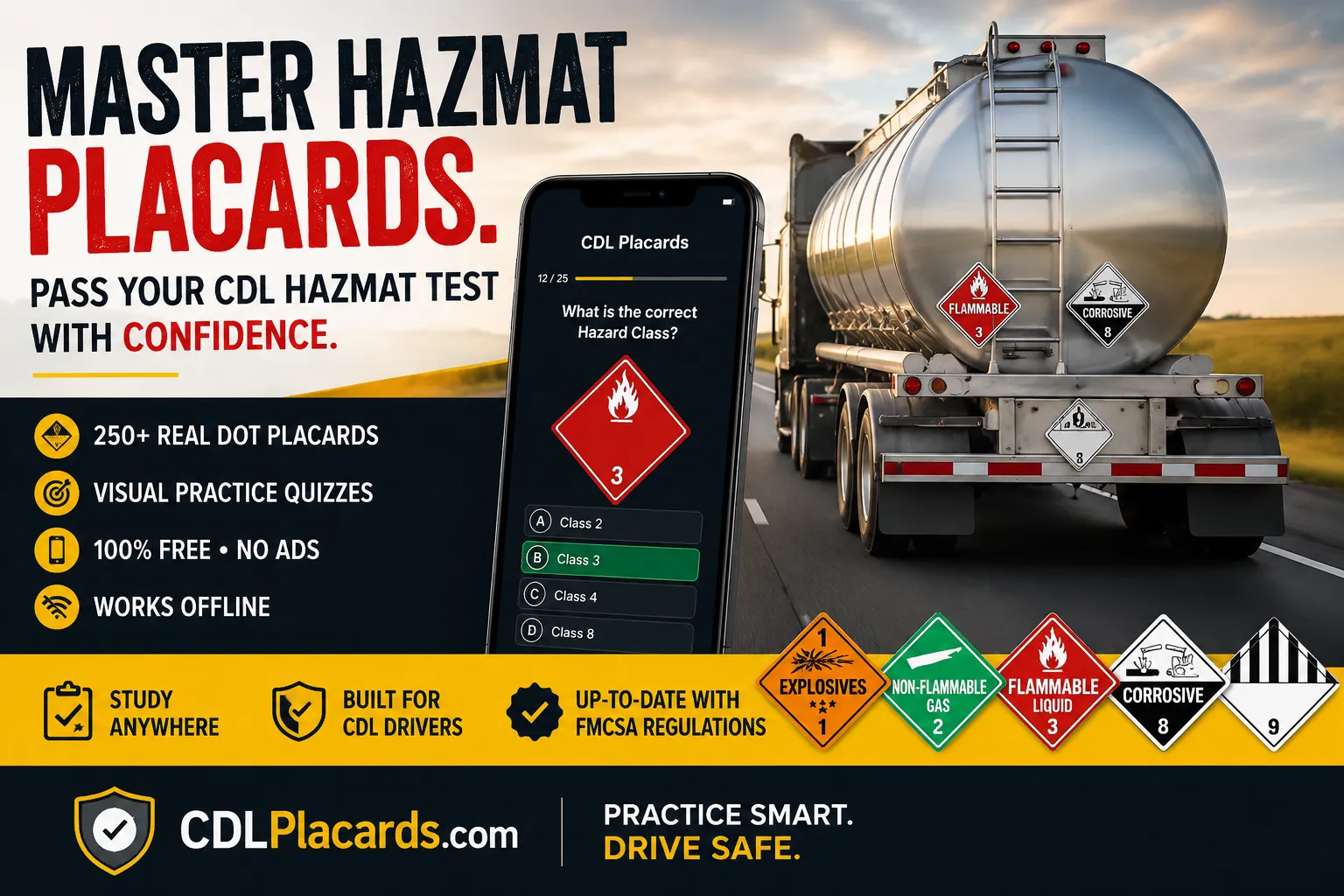
Why flashcards work for placard recognition
Active recall is the act of pulling an answer out of your memory rather than recognizing it on a page. It is harder than re-reading, and that difficulty is exactly why it works. Every time you successfully recall what a placard means, the memory gets a little stronger.
Flashcards also pair naturally with spaced repetition, where cards you know come back less often and cards you miss come back sooner. That keeps your study time focused on the placards that are not yet automatic.
What should be on each placard card
A good placard flashcard shows the visual on one side and the meaning on the other. The front should test recognition, so it shows the diamond, color, symbol, and class number without naming the hazard. The back confirms the answer and adds a short, plain explanation.
- Front: a generic hazard diamond with its color and symbol
- Front: the class number, if shown on the placard
- Back: the hazard class and what it means in plain words
- Back: a quick note on what it is easy to confuse this with
How to review mistakes
The cards you miss are the most valuable ones, because they show you where your recognition breaks down. Instead of reshuffling everything, pull your missed cards into a separate pile and drill that pile more often.
Review your misses daily while they are fresh. A placard you got wrong today should reappear tomorrow, then a few days later once it sticks. This is the core idea behind the mistake-review feature in CDL Placards.
Why generic flashcards are not enough
General flashcard apps can hold any deck, but they are not built around visual hazard recognition. You end up making your own cards, finding placard images, and managing decks by hand. That is a lot of setup before you have studied anything.
A purpose-built tool removes that friction. The placards are already there, organized by hazard class, with similar-sign comparisons and a review pile that fills automatically. You spend your time practicing, not building decks.
Planned CDL Placards flashcard modes
CDL Placards is designed around a few focused modes: a quick daily drill, a timed quiz that mirrors test pressure, a similar-sign mode that puts look-alike placards next to each other, and a mistake-review pile that brings back the ones you miss. A recognition score ties it together so you can see progress.
These are planned features for the iOS app, which is currently in validation. You can try a small demo drill on the practice page today.
Flashcard study checklist
- Put the visual on the front and the meaning on the back
- Test recognition first, then confirm with a short explanation
- Separate the cards you miss into their own pile
- Review missed cards daily, then space them out as they stick
- Group look-alike placards and drill them together
- Cross-check every card against your official CDL manual
Frequently asked questions
- Do flashcards work better than reading the manual?
- They do different jobs. The manual teaches you the material and is your source of truth. Flashcards train fast recall of the visuals. Use both: read first, then drill with cards.
- How many placard flashcards should I review a day?
- Quality matters more than quantity. A focused set of ten to twenty cards a day, with extra attention on your misses, is more effective than racing through hundreds once.
- Can I make my own Hazmat placard flashcards?
- Yes, and that is a fine way to start. A purpose-built tool just saves the setup time and adds features like a self-filling mistake pile and similar-sign comparisons.
Drill placard flashcards on your phone
Join the CDL Placards waitlist for free early access to the flashcard drills and the free study checklist.