Sitting in the dmv need quick flashcard summary for hazard classes
Here is the quick summary: nine hazard classes, each with a color and a symbol. Class 1 explosives (orange), 2 gases (red, green, or white), 3 flammable liquids (red), 4 flammable solids (red-and-white, blue), 5 oxidizers (yellow), 6 poison (white), 7 radioactive (yellow over white), 8 corrosives (white over black), 9 miscellaneous (white with stripes).
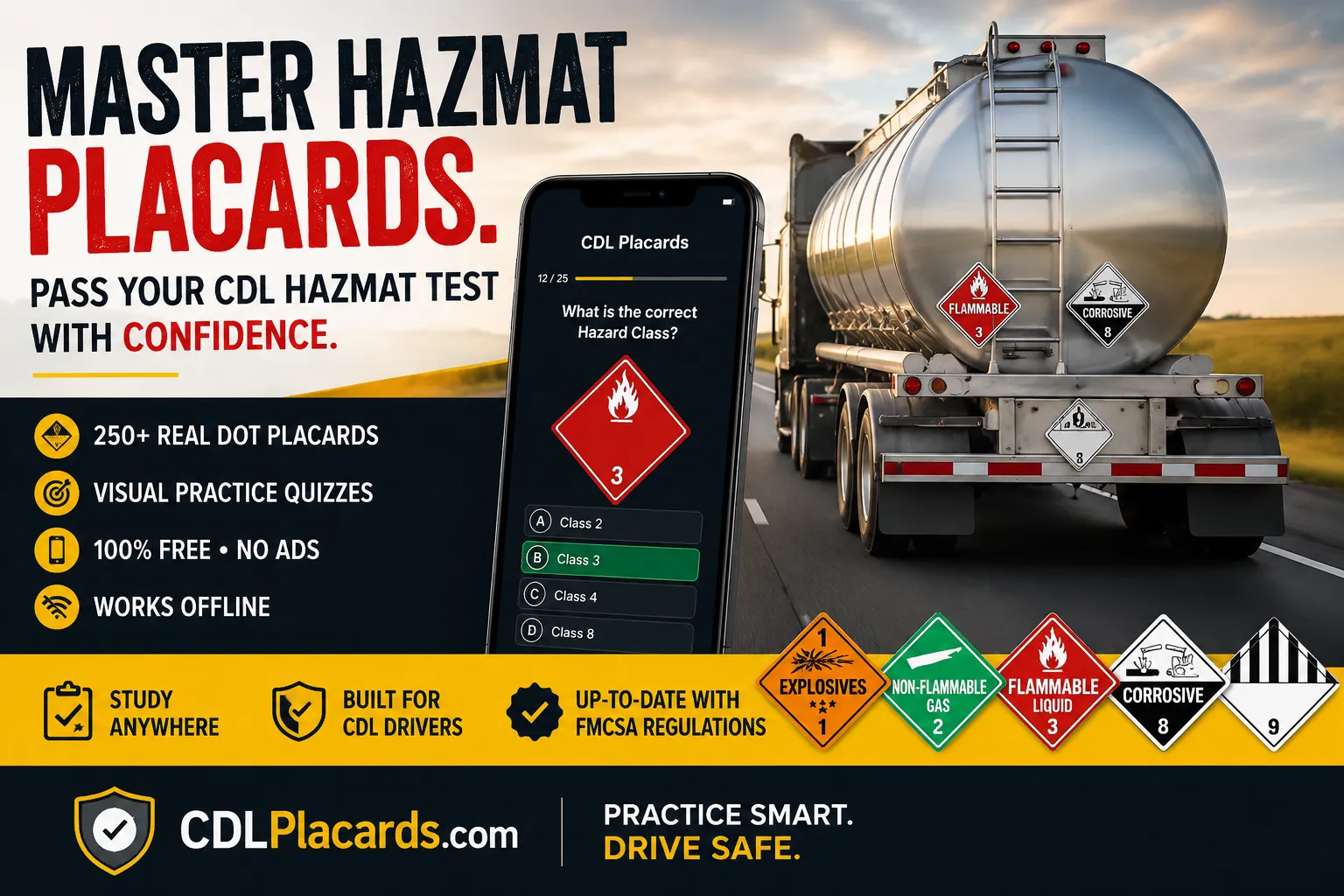
The nine classes at a glance
If you need a last-minute recap, the whole system comes down to nine classes, each tied to a color and a symbol. Get these and you can read almost any placard. Here is the quick table.
| Class | Color | Hazard |
|---|---|---|
| 1 | Orange | Explosives |
| 2 | Red / green / white | Gases (flammable / non-flammable / toxic) |
| 3 | Red | Flammable liquids |
| 4 | Red-and-white / red / blue | Flammable solids, dangerous when wet |
| 5 | Yellow | Oxidizers and organic peroxides |
| 6 | White | Poison and infectious |
| 7 | Yellow over white | Radioactive |
| 8 | White over black | Corrosives |
| 9 | White with black stripes | Miscellaneous |
The nine classes by color. Confirm specifics in your official CDL manual.
Read it color first
When a placard comes up, read the color first to land on the family, then the symbol to confirm the type, then the class number to pin it down. That fixed order, color then symbol then number, is the fastest way to decode any diamond, and it is the habit to carry into the test.
The look-alikes to watch
In the last few minutes, give extra attention to the pairs that get confused: Class 8 versus Class 9 (both black and white), poison 6.1 versus toxic gas 2.3 (both white with a skull), and the three Class 2 gas divisions (red, green, white). Those are where quick points are won or lost.
Quick memory hooks
A few anchors help: orange is explosives, red is flammable, green is non-flammable gas, yellow is oxidizer, blue is dangerous when wet, yellow-over-white is radioactive, white-over-black is corrosive, and stripes are miscellaneous. Tie each color to its family and the rest follows.
Before you go in
Run the nine classes by color once more, then the look-alikes, and you have the core covered. Remember this is a quick recap, not the full rulebook, so for the exact details and anything your state emphasizes, your official state CDL manual is the authority. Good luck.
Frequently asked questions
- What is a quick summary of the nine hazard classes?
- 1 explosives (orange), 2 gases (red/green/white), 3 flammable liquids (red), 4 flammable solids (red-white/blue), 5 oxidizers (yellow), 6 poison (white), 7 radioactive (yellow-over-white), 8 corrosives (white-over-black), 9 miscellaneous (striped). Confirm in your official manual.
- What is the fastest way to read a placard?
- Color first to find the family, then the symbol to confirm the type, then the class number to pin it down. That order decodes any diamond quickly.
- What should I review right before the test?
- The nine classes by color, then the look-alikes: Class 8 vs 9, poison 6.1 vs toxic gas 2.3, and the three Class 2 gas divisions. Those are common point-losers.