Do roadie drivers need to identify dot placards class 9 flash visual guide drill free app…?
If you move freight for hire, yes, recognising Class 9 is worth your time. Class 9 is the miscellaneous class shown as a white diamond with black vertical stripes on the top half and a 9 at the bottom, and it covers lithium batteries and similar modern commodities.
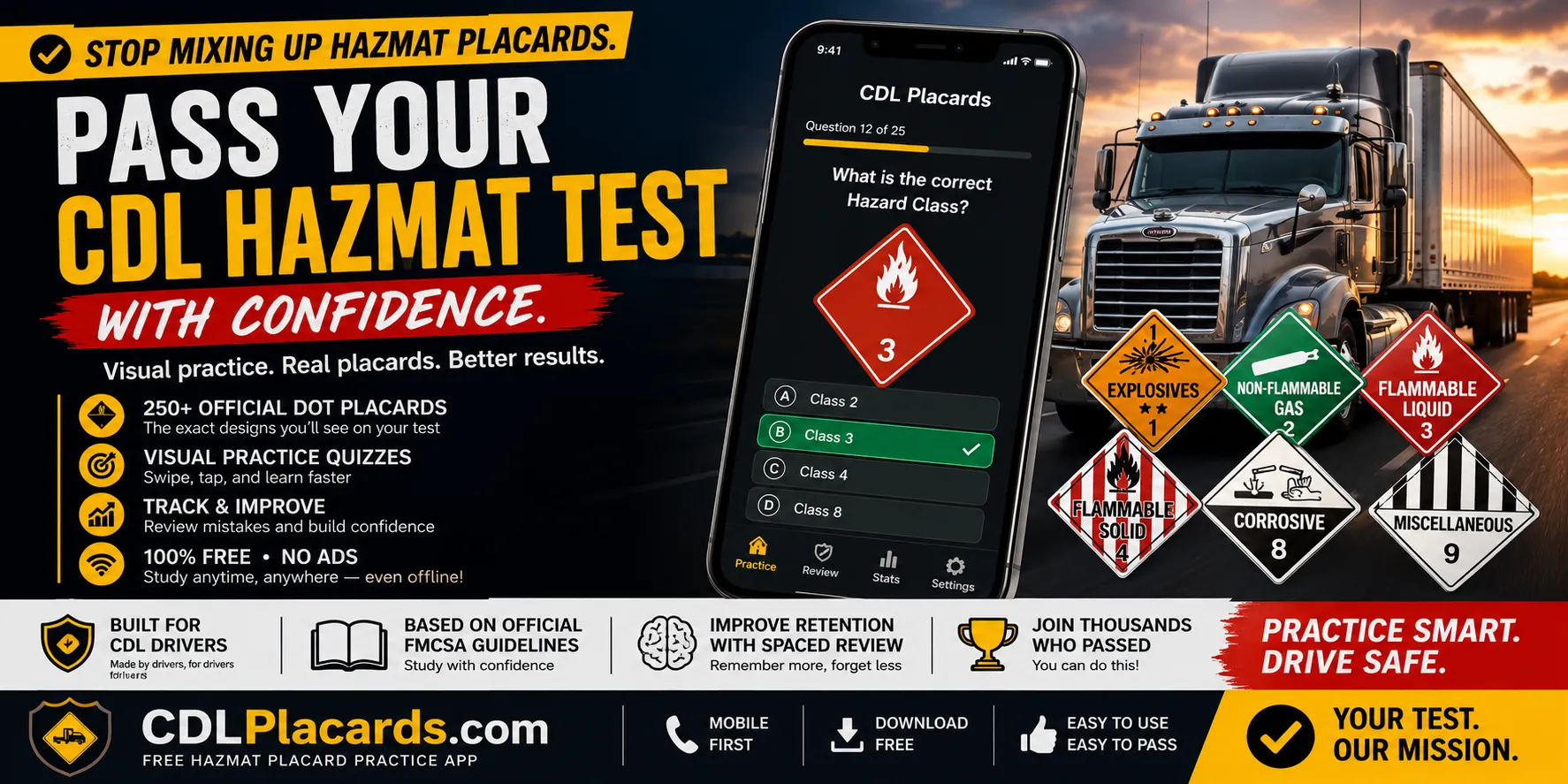
What Class 9 actually looks like
The Class 9 diamond is easy to recognise once you have seen it: black vertical stripes across the top half, a plain lower half, and the number 9 at the bottom point. There is no flame, skull or cylinder, because the class exists for hazards that do not fit the other eight.
That absence of a symbol is what makes people miss it. Learners who study by symbol alone often skip Class 9 entirely, then meet it on a test question or in a delivery bay and have nothing to match it against.
The lithium battery case, which is where gig work meets Class 9
Lithium batteries are the modern reason this class matters to drivers who never expected to handle hazardous materials: power tools, e-bikes, scooters, laptops, spare battery packs and battery-powered equipment all involve them.
Packages containing lithium batteries commonly carry a dedicated lithium battery mark, which is a separate marking from the Class 9 placard on a vehicle. Seeing that mark on a box does not by itself mean the vehicle needs a placard, and the shipping paper plus the quantity carried are what decide it.
| Marking | Where it appears | What it tells you |
|---|---|---|
| Class 9 placard | On the vehicle | Miscellaneous dangerous goods aboard |
| Class 9 label | On the package | That package is Class 9 |
| Lithium battery mark | On the package | Lithium cells or batteries inside |
| Shipping paper | In the cab | What is actually being carried |
Package markings and vehicle placards answer different questions. Confirm placarding thresholds in the official regulations.
Why this matters for contract and hotshot work
Gig and contract drivers frequently pick up freight they did not pack and cannot see inside. The practical skill is not memorising every rule; it is recognising the markings well enough to ask the right question before the load goes on the truck.
If a package shows a hazard marking you cannot identify, that is the moment to check the shipping paper and, where needed, decline until it is resolved. An unplacarded load that should have been placarded is the driver's problem at a roadside inspection, whoever packed it.
The common misreading
Assuming that miscellaneous means minor. Class 9 includes materials that present a real hazard in transport, and lithium batteries in particular are treated seriously because of fire risk when damaged or short-circuited.
The other misreading is expecting a symbol. Train your eye on the stripes-plus-9 pattern specifically, since that is the only cue this class gives you. Verify the current requirements in the official regulations and your state CDL manual.
Practise the one diamond with no symbol
Picture a white diamond with black vertical stripes on the top half and a 9 at the bottom. Say the class name. Then picture the lithium battery mark and say whether it is a vehicle placard. Run the set in a free 3-minute placard drill, or take the free visual Hazmat placard cheat sheet PDF with you.
Frequently asked questions
- Do contract and gig drivers need to recognise Class 9 placards?
- If you carry freight for hire, it is worth knowing, because Class 9 covers lithium batteries and similar commodities that appear in ordinary-looking parcels. The practical skill is recognising the marking and checking the shipping paper before loading. Whether a placard is required depends on quantity and shipment type under the official regulations.
- What does the Class 9 placard look like?
- A white diamond with black vertical stripes across the upper half, a plain lower half, and the number 9 at the bottom point. It carries no hazard symbol, which is why learners who study by symbol alone often miss it entirely. Confirm the current design in your official state CDL manual.
- Is a lithium battery mark the same as a Class 9 placard?
- No. The lithium battery mark goes on packages to indicate lithium cells or batteries inside, while a placard goes on the vehicle. Seeing the mark on a box does not by itself mean the vehicle requires a placard, since that depends on the shipment. Check the shipping paper and the official regulations.