Does memorizing class names or shapes work faster tests for visual adr cdls software adhd…?
Shapes and colors win for speed, names win for accuracy, and the fastest reliable route is to learn the visual pattern first and attach the class name to it afterwards. Recognition is quicker than recall, so train the eye, then label what the eye already finds.
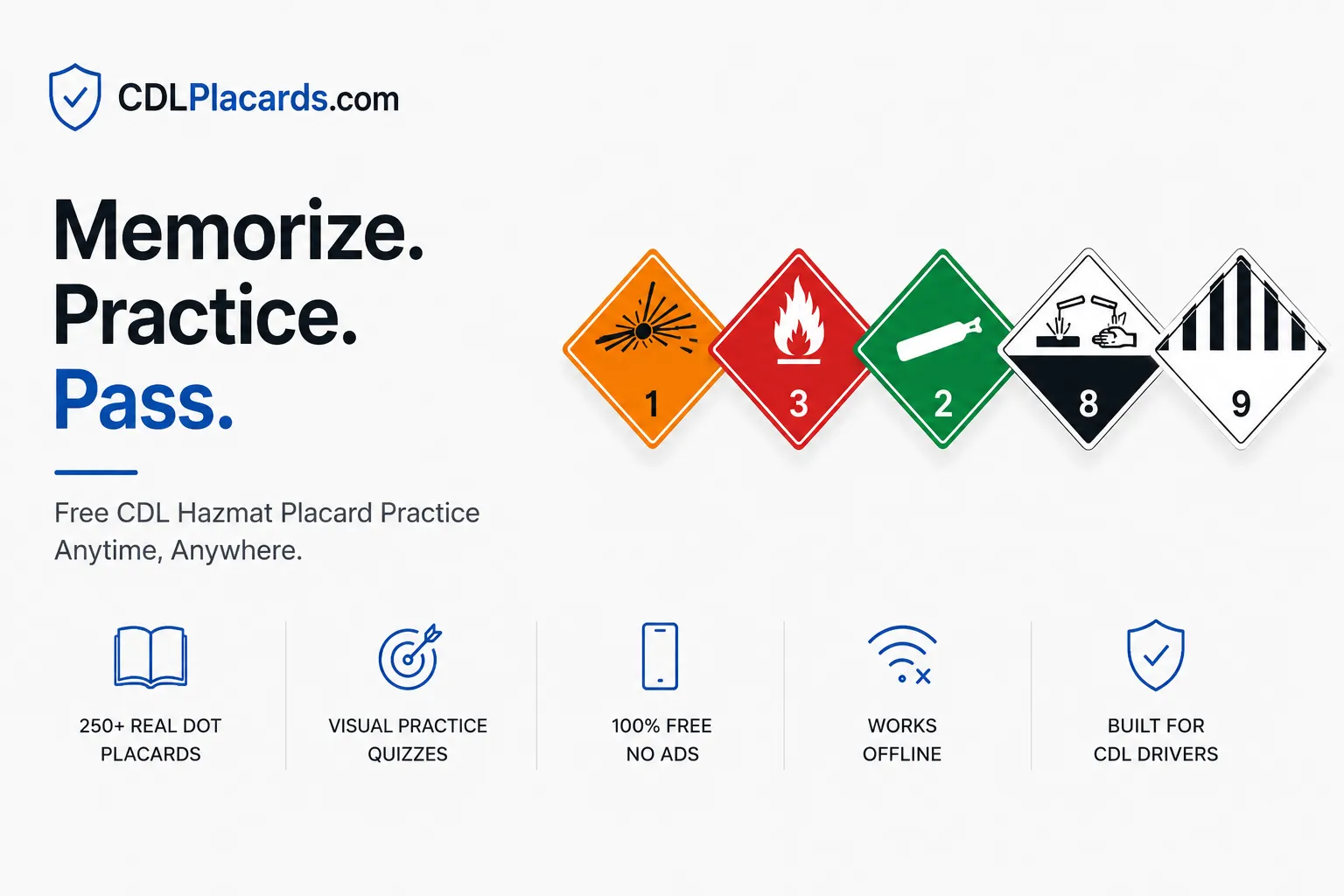
Why the visual route is usually faster
Recognising something you have seen before takes less effort than retrieving a word from memory, and a hazard diamond is built to be recognised: a color family, a symbol, and a class number, all in one glance. That is the same design logic a road sign uses, and it is why the placard system works at highway speed.
Class names are still needed, because a written question can name a class without showing a picture, and because you have to say the right thing to an inspector. The efficient order is to build the visual pattern first, since it comes fastest, then attach the vocabulary to a picture you can already identify.
For learners who find text-heavy study draining, this order also reduces the load: you are recognising nine or so familiar images rather than memorising a list of terms with no hook.
A three-layer way to learn each diamond
Take the layers in the order the eye takes them. Color narrows the field to a family. The symbol inside the diamond separates two things sharing a color. The class number at the bottom point fixes the exact class. Learn them in that sequence and each layer has less work to do.
| Layer | What it gives you | How to drill it |
|---|---|---|
| Color | The hazard family in under a second | Flash the color only, name the family |
| Symbol | Which hazard within that family | Cover the number, name the hazard |
| Class number | The exact class or division | Show the diamond, say the number |
| Class name | The words for a written question | Say the name out loud after the number |
Colors are shared across some classes, so the symbol and number always confirm. Verify specifics in your official CDL manual.
The mistake that slows people down
The common error is trying to memorise all nine class names as a list before ever looking at the diamonds. Lists without pictures decay quickly, and under test pressure they come back in the wrong order, which is exactly when two similar-sounding classes get swapped.
The second mistake is studying in long sessions. Short repeated exposure works better for visual recognition, and it is far easier to sustain if focus is the thing you struggle with. Five minutes done four times in a day beats twenty minutes done once.
A quick drill you can do right now
Picture a red diamond with a flame and the number 3, then say what it is. Then a green diamond with a gas cylinder. Then a white diamond with a skull. If any of the three took longer than a second, that is the one to drill next, and the answer is in the class list in your official state CDL manual.
Repeat the same three tomorrow before adding new ones. Adding a class only once the previous set is instant is what keeps the whole set from blurring together.
Where to practise
A short visual drill matches the way these questions are actually asked, so start a free 3-minute placard drill and see which diamonds slow you down. If reading on screen is the tiring part, the free visual Hazmat placard cheat sheet PDF gives you the same set on one page to keep in the cab.
Frequently asked questions
- Is it better to memorize hazard class names or the placard shapes?
- Learn the visual pattern first, then attach the name. Recognition is faster than recall, and most placard questions are recognition tasks. Class names still matter for written questions and for speaking to an inspector, so they follow rather than lead. Confirm the class list in your official state CDL manual.
- How long does it take to learn the nine hazard classes?
- Most learners recognise the main color families within a few short sessions, and the harder look-alikes take longer because they share a color. Short repeated drills work better than long sessions for visual recognition. There is no fixed timeline, so use accuracy on the look-alikes rather than hours studied as your measure.
- Which placards are easiest to confuse visually?
- The ones sharing a color: red covers both flammable liquids and flammable gases, and white appears on poison, corrosive and radioactive materials in different arrangements. This is why the symbol and the class number are always the confirming layer, and why the look-alike pairs deserve extra drilling. Verify each pair in your official manual.