Explosive 1.1 vs 1.6 hazard class app practice differences
Both are Class 1 explosives on the same orange diamond, so the division number is what changes the meaning. Division 1.1 has a mass explosion hazard and is the most dangerous. Division 1.6 is extremely insensitive articles with no mass explosion hazard, the least. The placard shows EXPLOSIVES, the division, and a compatibility group letter.
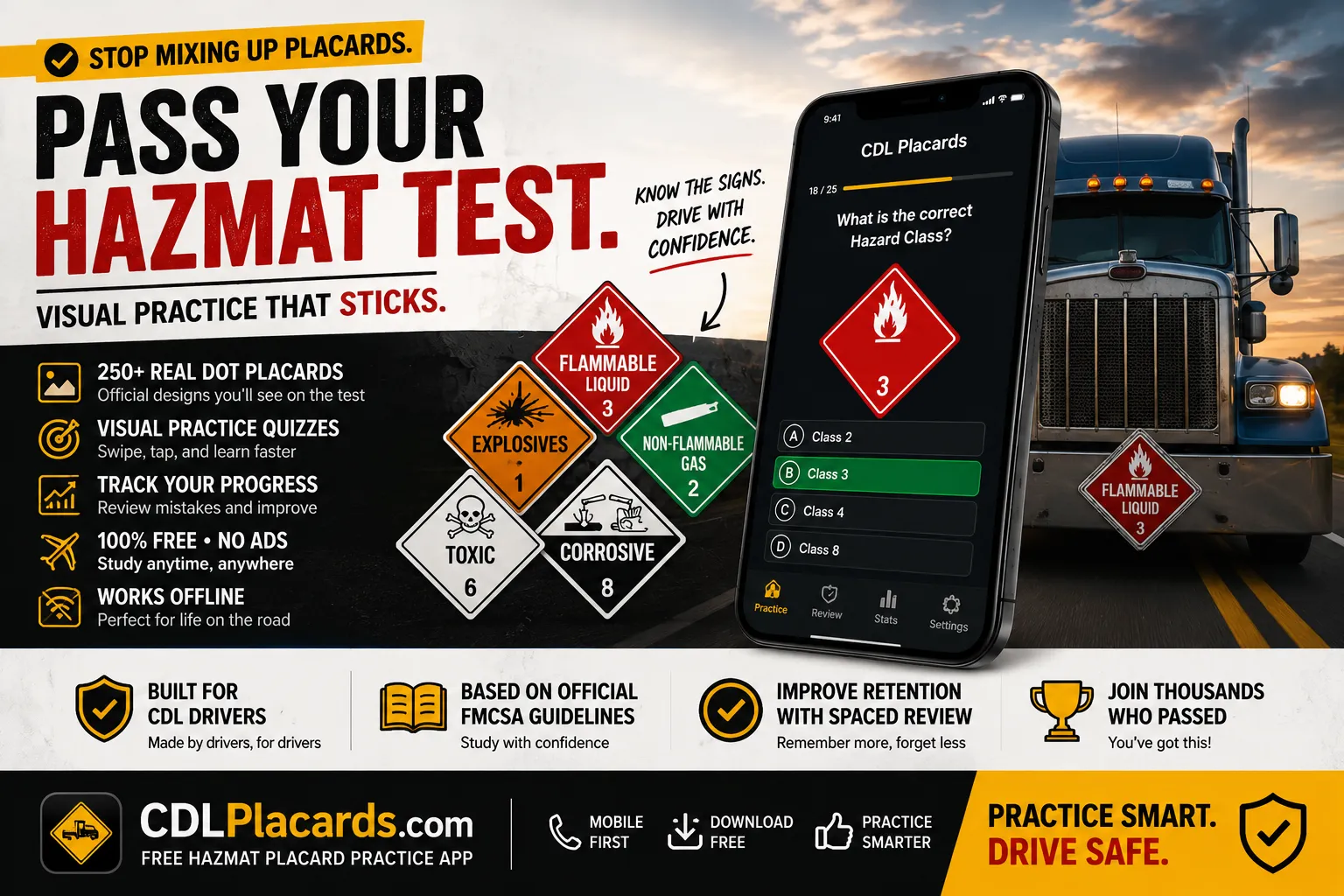
Same orange diamond, different division
Class 1 explosives all use an orange placard. The number after the dot, from 1.1 to 1.6, is the division, and it changes everything about how the material behaves. Reading only the color and the 1 is not enough.
What 1.1 and 1.6 mean
Division 1.1 is a mass explosion hazard: the whole load can detonate essentially at once. It is the most dangerous division. Division 1.6 is extremely insensitive articles with no mass explosion hazard, the least dangerous. The six divisions, 1.1 through 1.6, run roughly from the greatest explosion hazard to the least sensitive.
The compatibility group letter
Class 1 placards also carry a letter, the compatibility group, which controls which explosives can be loaded and transported together. It is part of why explosives are placarded and handled so carefully. Confirm the specifics in your official manual.
Frequently asked questions
- What is the difference between Division 1.1 and 1.6?
- Division 1.1 is a mass explosion hazard and is the most dangerous; Division 1.6 is extremely insensitive articles with no mass explosion hazard and is the least. Both are Class 1 on the orange placard. Confirm details in your official manual.
- How many explosive divisions are there?
- Class 1 has six divisions, 1.1 through 1.6, ordered roughly from the greatest explosion hazard to the least sensitive. Your manual lists what each one covers.
- What is the letter on an explosives placard?
- It is the compatibility group, which governs which explosives can be transported together. Verify the rules in the official regulations.