Company CDL fleet dangerous goods review test mobile drill tool link
For a company fleet review, the goal is consistent placard recognition across all drivers: everyone should identify the nine hazard classes by color, symbol, and number, and know the look-alikes. A shared drill works best when it is short, visual, and repeatable, so drivers can refresh quickly. The content is the same standardized nine-class system for every driver.
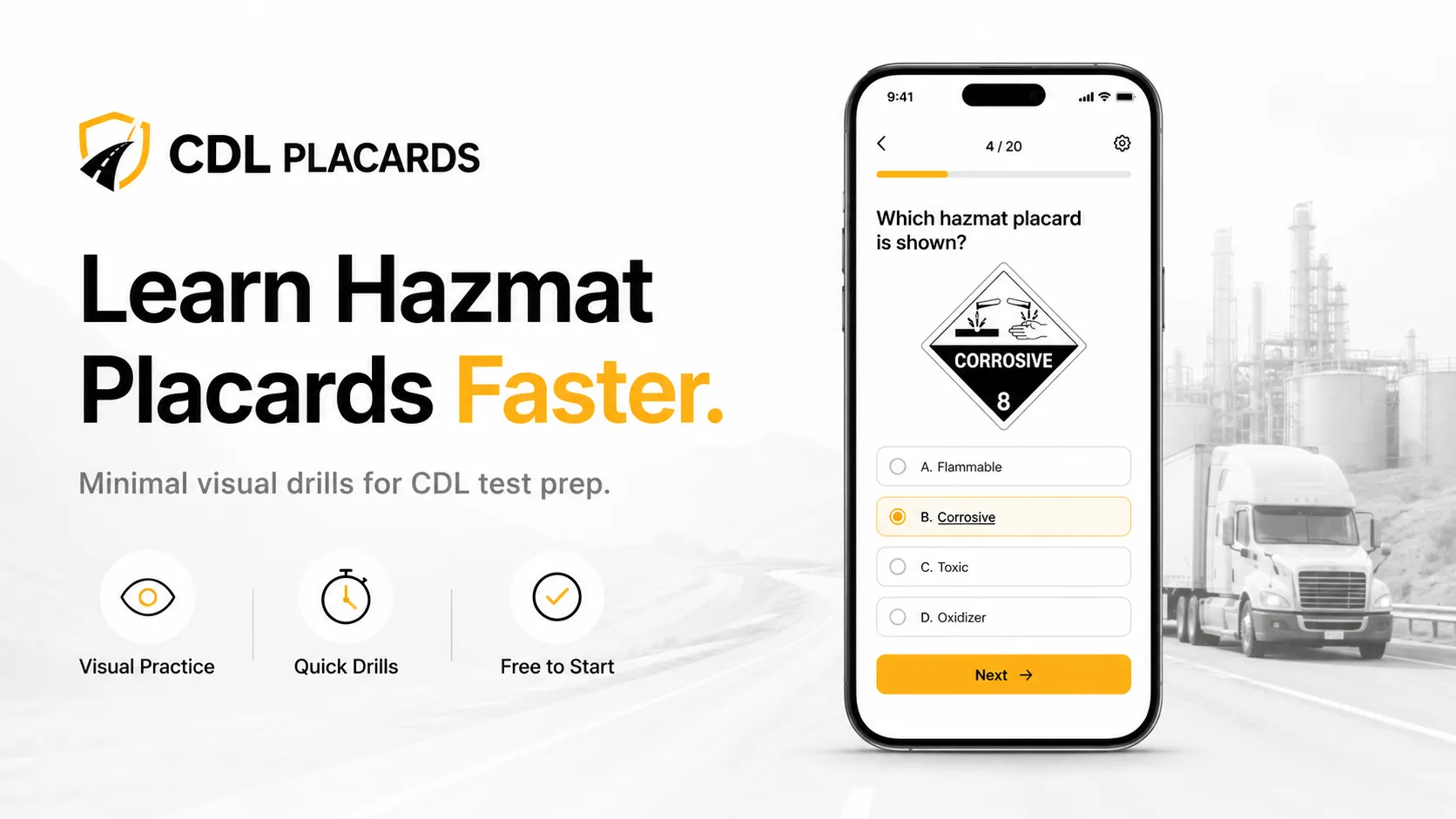
Consistency across drivers is the goal
When reviewing dangerous-goods recognition across a fleet, the aim is that every driver reads placards the same, correct way. A shared review removes the variation between someone who learned it years ago and someone newer. The baseline is the nine hazard classes plus the look-alikes, the same for everyone regardless of route or seniority.
What a fleet review should cover
The shared recognition baseline:
| Topic | Why for the whole fleet |
|---|---|
| Nine classes by color | The core recognition |
| Symbols and numbers | Confirm the class |
| The look-alikes | Where mistakes cluster |
| Legibility and placement | Practical compliance awareness |
A shared baseline for every driver. Confirm requirements with the regulations and your safety team.
Make the drill short and repeatable
Drivers are busy, so a fleet drill works best when it is short, visual, and easy to repeat: see a placard, name the class, check. Brief, frequent refreshers keep recognition sharp better than one long annual session, and they fit around driving schedules. The format should make it easy to redo periodically.
Why the content is standardized
Because placards are federally standardized, a fleet review teaches one correct system that applies to every load and every driver. There is no company-specific version of the nine classes; the diamonds are the same everywhere. That makes a shared review straightforward: one accurate set of placards, drilled consistently across the team.
How to set it up and verify
Build the review around the nine classes and the look-alikes, keep it short and visual, and have drivers refresh it regularly. For what your operation is actually required to train and document, and any role-specific rules, those come from the regulations and your safety program, so confirm the requirements there and in the official manual rather than assuming.
Frequently asked questions
- What should a company fleet dangerous-goods review cover?
- The shared recognition baseline: the nine hazard classes by color, symbol, and number, the look-alikes, and practical legibility and placement awareness. The content is the standardized nine-class system. Confirm training requirements with the regulations and your safety team.
- How do you keep fleet recognition consistent?
- Give every driver the same baseline, the nine classes and the look-alikes, with a short, visual, repeatable drill so newer and veteran drivers read placards the same correct way.
- Is the review content different per company?
- No. Placards are federally standardized, so there is one correct nine-class system for every fleet and load. A shared review teaches that single accurate set, drilled consistently.