Avalanche control team DOT class 1 transport visually matching test drill online flash fr…
Avalanche control explosives are Class 1, so the load carries the orange EXPLOSIVES placard with a division number and a compatibility group letter. Visually, orange is the giveaway; the number after the decimal point is what tells you how the material behaves.
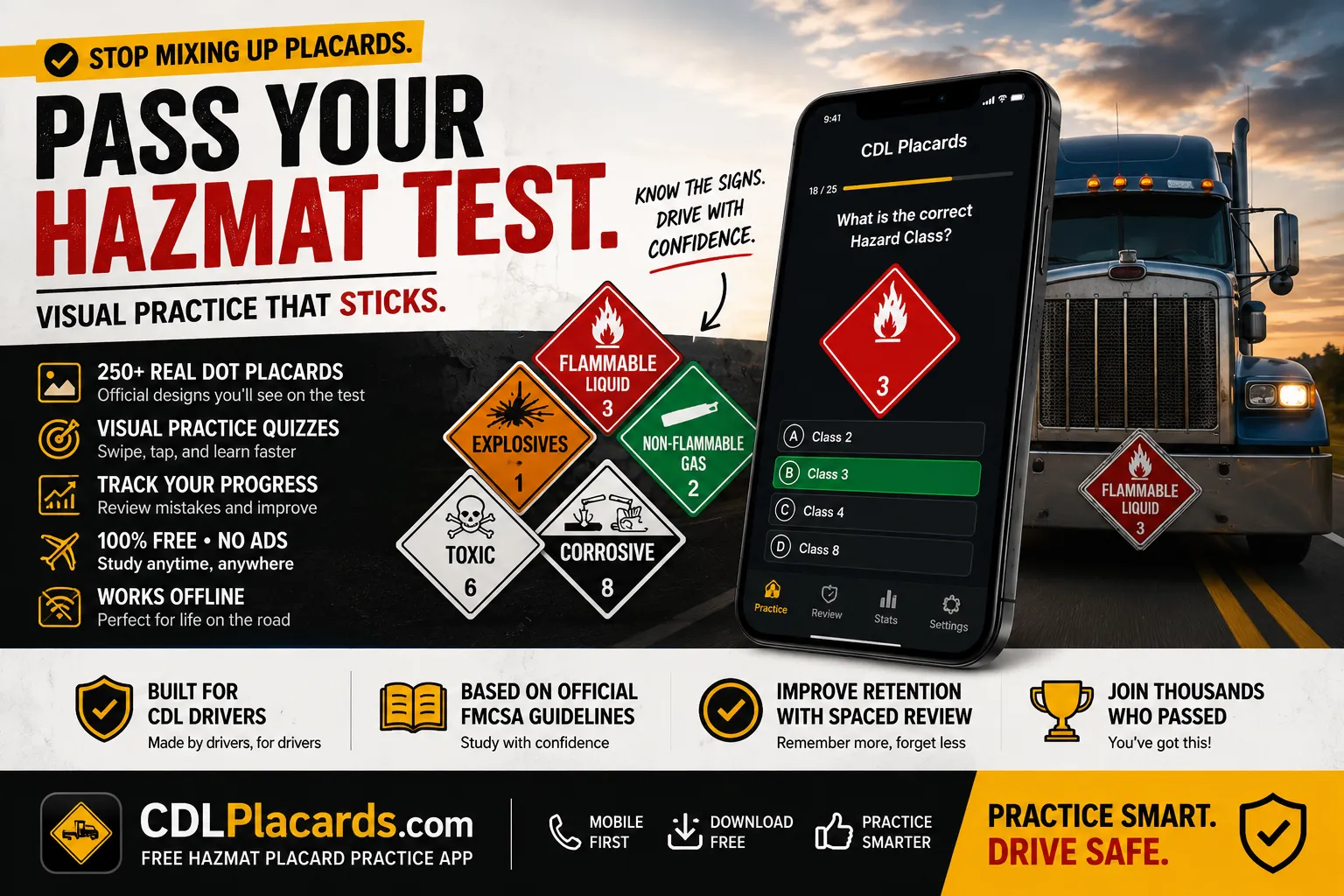
What the orange diamond tells you
Orange means explosives, and it is the fastest identification on the road because no other class uses it. What varies is the wording and the numbers: a placard may read EXPLOSIVES with the division, or show the division and a compatibility group letter such as 1.1D or 1.4S.
The division is the important part for anyone working near the load. It describes the hazard the material presents, from mass explosion hazard at one end of the scale to relatively insensitive articles at the other.
The six divisions, in the order they matter
Learning these as a sequence rather than as separate facts makes them stick, because the numbering runs roughly from most severe to least. The compatibility group letter that follows the division tells you what may be transported and stored together.
| Division | What it indicates | Typical thinking |
|---|---|---|
| 1.1 | Mass explosion hazard | The whole load can go at once |
| 1.2 | Projection hazard | Fragments, not mass explosion |
| 1.3 | Fire hazard, minor blast or projection | Burns fiercely |
| 1.4 | Minor explosion hazard | Effects mostly within the package |
| 1.5 | Very insensitive, mass explosion hazard | Hard to start, severe if it does |
| 1.6 | Extremely insensitive articles | No mass explosion hazard |
The letter after the division is the compatibility group. Confirm divisions and segregation in the official regulations.
Why avalanche work looks confusing
An avalanche control operation moves the charges and the devices that initiate them, and those are not always in the same division or compatibility group. That is precisely why the letter exists, and why the paperwork matters as much as the placard on the trailer.
For anyone loading, staging or receiving this freight, the practical rule is that orange means stop and read: read the division, read the letter, and read the shipping paper rather than assuming that all explosives are one thing.
The mistake test-takers make
Reading 1.4 as harmless. A lower division number describes a different hazard profile, not the absence of hazard, and the placarding and handling rules still apply. The second common error is ignoring the compatibility letter entirely, which is the piece that governs what can travel alongside what.
Placarding thresholds for Class 1 are stricter than for many other classes, so treat any quantity as a reason to check the rules rather than to estimate. The authority here is the federal regulations and your state CDL manual.
Drill it until orange is automatic
Try this now: picture an orange diamond reading 1.1D and say what it means, then 1.4S. If the second one made you hesitate, that is the pair to work on. Start a free 3-minute placard drill to run the Class 1 set, or take the free visual Hazmat placard cheat sheet PDF with you for the divisions in one glance.
Frequently asked questions
- What placard is used for avalanche control explosives?
- The orange Class 1 explosives placard, showing the division and often a compatibility group letter such as 1.1D or 1.4S. Orange is unique to explosives, which makes it the fastest visual identification. The exact placard and quantity thresholds depend on the material and are set by the official regulations.
- What is the difference between 1.1 and 1.4 explosives?
- Division 1.1 indicates a mass explosion hazard, meaning the whole load can detonate essentially at once. Division 1.4 indicates a minor explosion hazard whose effects are largely confined to the package. Lower numbers do not mean harmless, and both are placarded. Confirm definitions in the official regulations.
- What does the letter after the explosives division mean?
- It is the compatibility group, which governs what may be transported and stored together. Charges and their initiating devices often carry different letters, which is why an avalanche control load is a common example of mixed groups moving under specific rules. Verify segregation requirements in the official regulations.