ADR mock exam tunnel restriction codes versus visual labels interactive quiz free checks…
They answer different questions. ADR hazard labels identify what the load is, while a tunnel restriction code says which tunnel categories the load may pass through. The code travels in the transport document rather than on the diamonds.
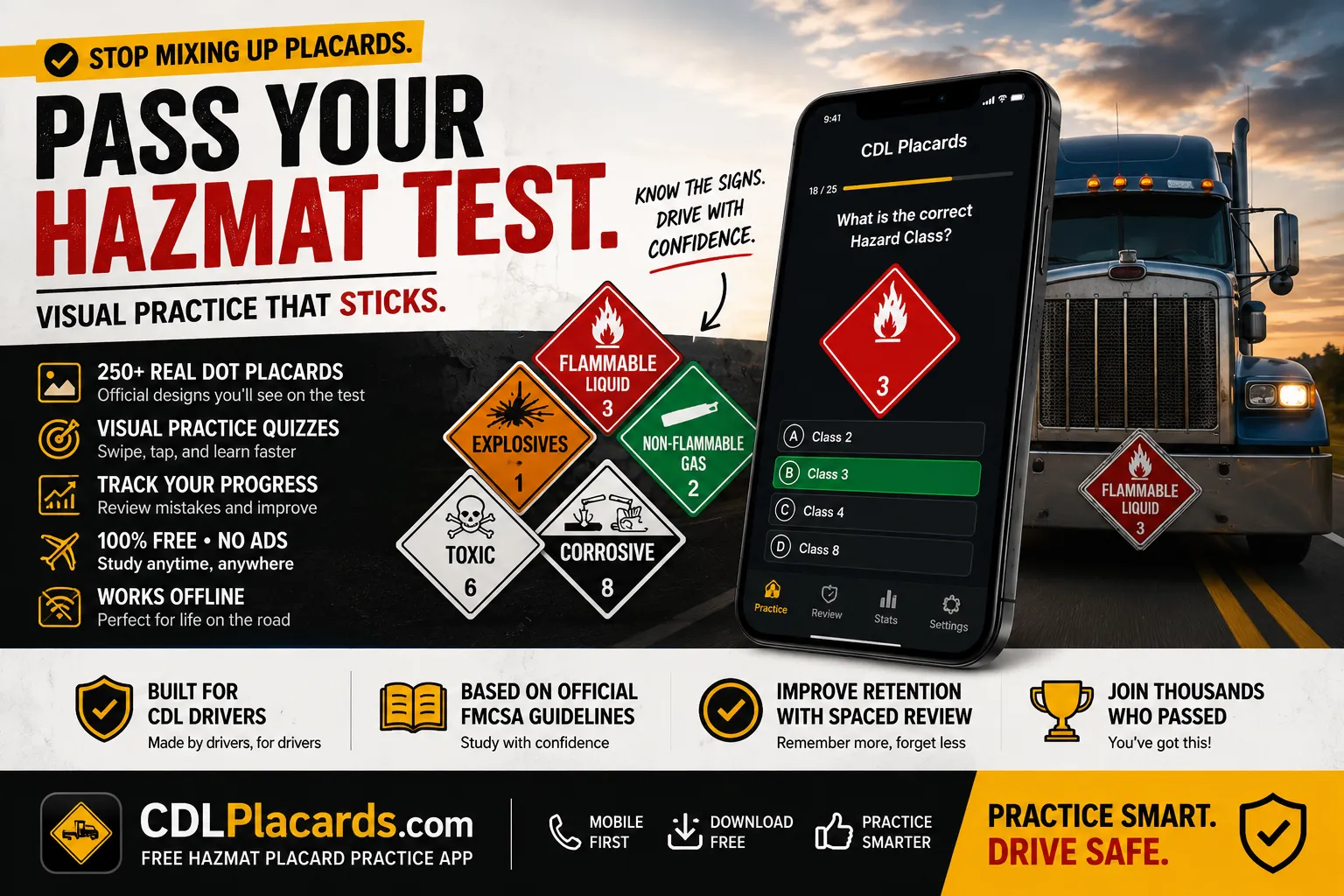
Labels identify, codes restrict
An ADR label answers what is on the vehicle: the diamond shape, its colour and its class number work exactly as the transport hazard system does elsewhere, built on the same nine UN hazard classes.
A tunnel restriction code answers where the vehicle may go. It is a letter assigned to the dangerous goods being carried, and tunnels are categorised so that a load carrying a given code is restricted from certain categories.
What to expect from each in a mock exam
Exam questions treat them differently, which is a useful hint about how to revise. Label questions are recognition tasks. Code questions are rule-application tasks, usually phrased as whether a given load may enter a given tunnel category.
| ADR labels | Tunnel restriction codes | |
|---|---|---|
| What it is | Hazard diamonds and orange plates | A letter assigned to the goods |
| Where it appears | On the vehicle and packages | In the transport document |
| Question style | Identify this marking | May this load use this tunnel |
| How to revise | Visual drills, repeated | Learn the letters as a short rule set |
Two separate systems that share an exam. Confirm both in the official ADR text.
The orange plate, which belongs to neither list
ADR also uses the plain orange rectangular plate, which on a tank carrying a single substance shows the hazard identification number over the four-digit UN number. It is a vehicle marking rather than a hazard diamond, and it is one of the most distinctive parts of the European system.
Learners who focus only on the diamonds are often surprised by orange-plate questions, so treat the plate as its own item to learn alongside the classes.
How to study both without mixing them
Keep them in separate sessions. Visual recognition and rule application use different kinds of memory, and interleaving them early tends to blur both. Drill the diamonds until identification is instant, then work through the tunnel codes as a small set of rules with worked examples.
When a mock exam mixes them, read each question for which system it is testing before answering. The words tunnel or category signal a code question; a described marking signals a label question. The official ADR text is the authority for both.
Start with the part that transfers
The hazard diamonds are shared across ADR and other transport systems built on the UN classes, so time spent on visual recognition carries over. Run the classes in a free 3-minute placard drill, then keep the free visual Hazmat placard cheat sheet PDF nearby while you work through the tunnel code rules separately.
Frequently asked questions
- What is a tunnel restriction code in ADR?
- A letter assigned to dangerous goods that limits which tunnel categories the load may pass through. It appears in the transport document rather than on the hazard diamonds, and it is applied as a rule rather than recognised visually. The categories and their meanings are set out in the official ADR text.
- Are ADR labels the same as tunnel codes?
- No. Labels are the hazard diamonds identifying what the load is, using the same UN hazard classes seen elsewhere. Tunnel restriction codes say where the load may travel. Exam questions treat them differently: labels are recognition tasks and codes are rule-application tasks, which is why they are best revised in separate sessions.
- What is the ADR orange plate?
- A plain orange rectangular vehicle marking. On a tank carrying a single substance it shows the hazard identification number over the four-digit UN number, and an unmarked orange plate can indicate a mixed dangerous-goods load. It is separate from the hazard diamonds, and learners who study only the diamonds often overlook it.